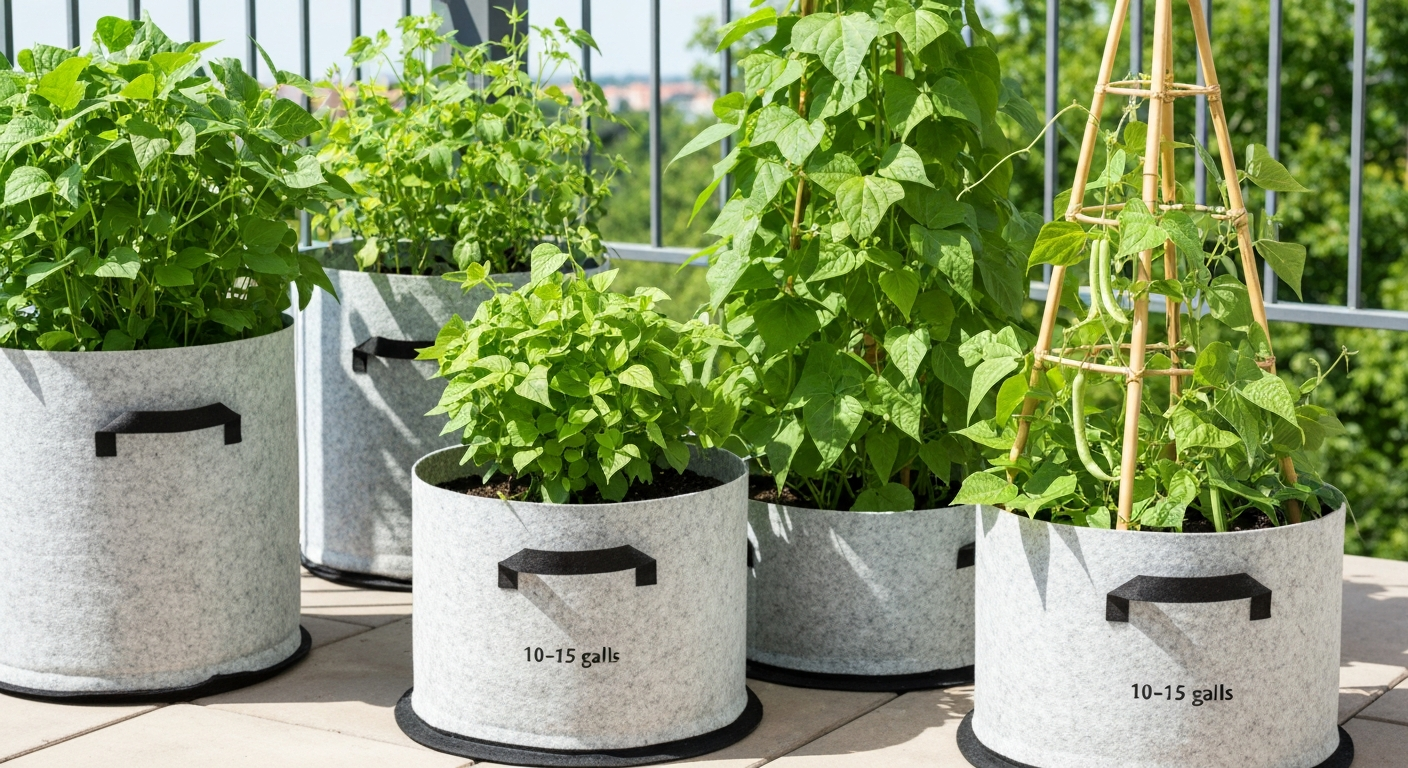
Yes, you can absolutely grow green beans in grow bags, and they do surprisingly well in fabric containers when you match the bag size to the variety. Bush types thrive in 5 to 10 gallon bags with no support needed. Pole beans work fine too, but they need at least a 10 gallon bag and a trellis or stake system to climb. The breathable fabric of a grow bag suits beans well because it prevents the waterlogging that kills more container beans than anything else.
Can You Grow Green Beans in Grow Bags? A Practical Guide
Marcus Holloway
15 Jul 2026
Why fabric grow bags are a solid choice for green beans
The reason grow bags work so well for beans comes down to drainage and air pruning. Fabric walls allow excess moisture to escape passively, which means the roots almost never sit in standing water. That matters because bean roots are highly susceptible to rot in waterlogged conditions. At the same time, as roots reach the fabric wall they are air pruned rather than spiralling around the container, which encourages a dense, fibrous root system that takes up water and nutrients more efficiently.
There is a trade-off to acknowledge honestly: that same breathability means fabric bags dry out faster than plastic pots or raised beds, sometimes dramatically so during a heatwave. Small bags on a sunny patio can dry to the point of wilting stress within a single day. You can offset this with consistent watering and mulching the soil surface, but it is a real management commitment. The other limitation is root volume. Research on Phaseolus vulgaris confirms that severe root restriction suppresses shoot growth and alters water stress signalling, so undersized bags will reduce your yield noticeably. Size the bag generously and you sidestep most of this.
- Excellent drainage prevents root rot, the most common killer of container beans
- Air pruning builds a healthier, denser root system
- Lightweight and easy to reposition as sunlight shifts through the season
- Breathable fabric keeps root-zone temperatures lower than dark plastic pots in summer
- Quality fabric bags (geotextile or recycled PET blends) last 3 to 5 years or more with basic care
- Bags dry faster than other containers, requiring more attentive watering in warm weather
- Root volume is limited by bag size, so choosing the right gallon capacity is critical for yield
Bush beans vs pole beans: which type works better in a bag
Bush beans are the easier choice for grow bags and my first recommendation to anyone starting out. They stay compact at 40 to 60 cm tall, need no support, and produce the bulk of their crop over a focused 2 to 3 week window. That concentrated harvest suits a container setup well. Pole beans produce over a longer season and can ultimately yield more per square foot, but they require both a larger bag and a reliable support structure. If you have space to anchor a trellis or cane teepee above the bag, pole beans are absolutely worth growing.
Recommended bush bean varieties for grow bags
- Provider: reliable germinator even in cooler soils, compact plant, heavy early yield
- Contender: fast-maturing (around 50 days), disease-tolerant, excellent for smaller bags
- Blue Lake Bush (Bush Blue Lake 274): classic flavour, uniform pods, widely available
- Topcrop: vigorous and heat-tolerant, good for warmer patio positions
- Mascotte: specifically bred for container culture, stays under 45 cm, very productive
Recommended pole bean varieties for grow bags
- Kentucky Wonder: long pods, prolific climber, suited to a 10 to 15 gallon bag with a 1.8 m support
- Cobra: slim French-style pods, excellent flavour, manageable height around 1.5 m
- Hestia (dwarf runner bean): specifically bred for containers, stays under 45 cm, no support needed — a great crossover option if you want runner bean flavour in a small bag
- Blauhilde (Blue Lake climbing): striking purple pods, reliable and productive on a teepee
For more variety options across different bean types and growth habits, the best beans to grow in a bag guide on this site covers the full range, including French climbing beans, borlotti and runner bean cultivars with specific container notes.
Choosing the right grow bag: fabric, size and shape
For fabric type, nonwoven geotextile bags (the standard black felt-like material used by brands such as Smart Pots) perform reliably for beans. Heavier fabric weights around 200 to 260 gsm hold their shape better and last longer outdoors. Lighter fabrics in the 100 to 150 gsm range work but tend to collapse when wet and degrade faster under UV. Recycled PET and natural-fiber blend fabrics (such as Root Pouch's Charcoal line at around 150 gsm or their Boxer line at 250 to 260 gsm) are another well-regarded option, particularly if sustainability matters to you. The key functional requirement for beans is that the fabric drains freely and does not hold water against the root zone.
Size is the most consequential decision. The minimum usable growing depth for beans is 20 to 30 cm (8 to 12 inches), and the practical gallon range depends on what you are planting. A single bush bean plant can manage in 2 to 3 gallons, but you will not get a meaningful harvest from one plant, so most growers aim for 5 to 10 gallons to fit multiple plants per bag. For pole beans, a 10 to 15 gallon bag provides enough root volume to support a productive multi-plant teepee. The RHS recommends at least 30 litres for climbing/runner beans in containers, which aligns with the upper end of that range.
| Bag size | Approx. litres | Best for | Plants per bag |
|---|---|---|---|
| 3 gallon | ~11 L | Single bush bean plant (trial/patio) | 1 to 2 |
| 5 gallon | ~19 L | Bush beans, compact patio setup | 3 to 4 |
| 7 to 10 gallon | ~26 to 38 L | Bush beans (group) or pole beans with trellis | 4 to 6 bush or 2 to 3 pole |
| 15 gallon | ~57 L | Pole bean teepee, runner beans | 3 to 4 pole/runner |
| 20 gallon+ | ~75 L+ | Large climbing setups, maximum yield | 4 to 6 pole/runner |
A word on hanging grow bags: standard shallow hanging pocket bags are not suitable for green beans. Beans need at least 20 to 30 cm of soil depth and a root volume of several litres per plant. Most hanging pocket bags offer 10 to 15 cm of effective depth, which will severely restrict bean roots and produce almost no harvestable yield. Dwarf runner bean varieties like Hestia in a large, deep hanging planter (essentially a hanging bucket-style bag of 5 gallons or more) are a borderline exception, but standard wall-mounted hanging bags are the wrong tool for this crop. If hanging containers are your main growing space, the what to grow in hanging grow bags guide covers which crops genuinely suit those constraints.
Planting calendar: when to sow and when to transplant
Green beans are warm-season crops with no frost tolerance. Do not direct-sow until the soil temperature at planting depth has reached at least 16°C (60°F). Below that threshold, germination is slow, uneven and seeds are prone to rotting rather than sprouting. The sweet spot for emergence is a soil temperature of 18 to 29°C (65 to 85°F), where seedlings typically appear within 7 to 10 days. Because grow bags warm faster than in-ground soil (the fabric walls allow heat exchange from all sides), they often reach sowing temperature a week or two ahead of your garden beds in spring, which is a genuine advantage.
| Climate zone | Earliest outdoor sow date | Main sow window | Latest sow for harvest |
|---|---|---|---|
| UK / Northern Europe (mild maritime) | Late May (after last frost, soil 16°C+) | Late May to late June | Mid-July |
| USDA zones 6 to 7 (mid-Atlantic, Midwest US) | Mid to late May | May to early July | Late July |
| USDA zones 8 to 9 (Southeast US, PNW) | April (spring) or August (fall crop) | April–June or Aug–Sept | October for fall crop |
| Mediterranean / warm temperate | March to April | March to June | August |
| Indoor/protected sowing (anywhere) | 4 weeks before last frost (in pots) | As above, transplant after last frost | — |
For most temperate growers, direct sowing into the grow bag outdoors is the standard approach, and beans generally prefer it over being transplanted because they resent root disturbance. If you want to get a head start in a short season, sow 2 to 3 seeds in small biodegradable pots or root trainers indoors 3 to 4 weeks before your last frost date, then transplant the rootball intact. Avoid sowing in standard plastic cell trays where roots spiral and break on removal.
Step-by-step planting instructions
- Fill your grow bag to within 3 to 4 cm of the top with your prepared potting mix (see the soil recipe section below). Firm lightly but do not compact.
- Water the mix thoroughly and allow it to drain before sowing. Planting into dry compost delays germination.
- Sow seeds 2.5 cm (1 inch) deep. This is important: too shallow and seeds dry out before germination; too deep in a cold spell and they rot.
- Space seeds 8 to 10 cm apart in a grow bag. For a 5 gallon bag, sow 4 to 6 seeds in a rough grid. For a 10 gallon bag, sow 6 to 8 seeds. You will thin to the strongest plants once they reach 5 to 8 cm tall.
- After thinning, final plant spacing should be approximately 10 to 15 cm for bush beans. For pole beans in a 10 to 15 gallon bag, keep 3 plants arranged in a triangle around a central support.
- For transplants started indoors, water the rootball well before moving, handle carefully to keep the rootball intact, plant at the same depth as in the nursery pot, and water in with a dilute seaweed solution.
- Top-dress with a thin layer of perlite or fine gravel on the soil surface to reduce moisture loss from evaporation and discourage fungus gnats.
- If using pole beans, install your support structure at or just after sowing — it is far easier to set stakes before plants establish than after.
There is no real need to pot on (move to a larger bag mid-season) if you have started in an appropriately sized bag. If you did start plants in small cells or 3-inch pots and roots are already circling before outdoor temperatures are safe, pot up into a 1-gallon intermediate container rather than leaving them pot-bound indoors. Move to the final grow bag as soon as frost risk has passed.
The soil mix that gives green beans the best start
Standard garden soil is too heavy and dense for grow bags. It compacts quickly, drains poorly through the fabric and deprives roots of the aeration that makes grow bags work. You want a lightweight, free-draining mix that still holds enough moisture to buffer between waterings. Here is the recipe I use and recommend based on established Cornell-style peat-lite principles adapted for organic growing:
- 40% coir or sphagnum peat moss (moisture retention and structure)
- 30% perlite (drainage and aeration — do not skimp on this in a grow bag)
- 20% quality finished compost (nutrient base and microbial activity)
- 10% vermiculite (additional moisture buffering and trace minerals)
To this base mix, add a slow-release organic fertiliser at the manufacturer's recommended rate (something with an NPK around 4-6-4 or similar balanced feed works well at planting). Beans fix their own nitrogen through rhizobial bacteria, so you do not want an excessively nitrogen-rich mix at sowing. Target a pH of 6.0 to 7.0, with 6.5 to 6.8 being the optimal range for most green bean cultivars. If you are using a peat-heavy mix, add a pinch of ground limestone to bring pH up from the naturally acidic baseline of peat.
One addition worth making: treat your seeds with a rhizobium inoculant before sowing, especially if the grow bag contains fresh potting mix with no prior legume history. Inoculants are inexpensive, widely available in garden centres and online, and the scientific evidence for improved nodulation and yield in new growing media is solid. Just moisten the seeds, roll them in the inoculant powder, and sow immediately. It takes about 30 seconds and can meaningfully improve nitrogen fixation.
Support and trellising for beans in grow bags
Bush beans: minimal support, maximum simplicity
Bush beans mostly support themselves, but in exposed positions or once pods form and plants become top-heavy, a few short canes (30 to 45 cm) pushed around the perimeter of the bag with a loop of twine connecting them acts as a simple corral. This stops wind from snapping stems at the base. That is genuinely all the support most bush varieties need.
Pole beans and climbing runner beans: stable support is non-negotiable
The main challenge with supporting pole beans in grow bags is that the bag itself has no rigid base to anchor into the ground. A cane teepee inserted directly into the bag works for lighter varieties on a sheltered balcony or patio. For taller or more exposed setups, anchor the support independently: use a freestanding obelisk placed over the bag, lean canes against a wall or fence, or attach netting to a fixed structure above and let beans grow up into it. Push bamboo canes at least 20 to 25 cm into the grow bag mix so they contact the bottom of the bag, which gives them enough purchase to stay upright under plant weight. A typical teepee uses 3 to 4 canes, 1.8 m tall, tied at the top, with one plant per cane.
Jute or polypropylene bean netting (10 to 15 cm mesh) attached to a wall or fence bracket above the bag is the most stable solution for a patio wall situation. Grow bag handles can be used to tie the bag loosely to the base of a fence post to prevent the whole setup tipping in wind. This is one area where planning ahead at sowing time pays off. Installing a trellis after the plants are 30 cm tall and tangled is a frustrating job.
Watering, drainage and feeding your bag-grown beans
Field-grown beans need roughly 25 mm (1 inch) of water per week. Container beans need more, and fabric grow bags need more still. For practical container watering guidance, Harvest to Table notes containers generally need more frequent irrigation than in-ground plantings, often daily or every‑other‑day for small bags in hot weather, with fabric/grow bags drying fastest and benefiting from drip or soaker irrigation to keep the root zone evenly moist. In warm summer weather, a 5 gallon grow bag in full sun may need watering every day or every other day. The test I use is straightforward: push a finger 5 cm into the soil surface. If it feels dry at that depth, water. If it is still moist, check again in 24 hours. Consistent moisture is especially important once flowers open, blossom drop and poor pod set are frequently caused by erratic watering, not heat or pests.
Water deeply when you do water, not lightly from above. Aim to wet the full depth of the bag so water drains from the base. A quick surface splash does little for the roots at the bottom. Drip irrigation or a soaker hose laid on the surface of the bag is ideal for consistency and keeps foliage dry, which reduces fungal disease risk. Mulching the soil surface with a 2 cm layer of compost or perlite reduces evaporative loss and helps extend the interval between waterings.
Feeding schedule
Beans fix their own nitrogen, so the feeding priority shifts toward phosphorus and potassium rather than high-nitrogen feeds. Over-applying nitrogen produces lush, leafy plants with poor pod set. Here is a practical schedule that works well:
| Growth stage | Feed type | Frequency |
|---|---|---|
| Sowing to first true leaves | None (rely on slow-release in mix) | — |
| Active vegetative growth (weeks 3 to 6) | Balanced liquid feed (e.g., 5-5-5 or seaweed), half strength | Every 2 weeks |
| First flowers forming | Switch to high-potassium feed (e.g., tomato feed) | Weekly |
| Pod fill to harvest | High-potassium liquid feed | Weekly |
| After first flush harvest (pole/runner types) | Balanced feed to encourage re-flush | Every 2 weeks |
Avoid foliar feeding in hot sun or when foliage is wet. Always water the bag before applying liquid feed to avoid fertiliser burn on dry roots.
Light, temperature and where to position your bags
Green beans need full sun, which in practice means a minimum of 6 to 8 hours of direct sunlight per day. A south or southwest-facing patio, balcony or garden wall is ideal in the northern hemisphere. Beans slow their growth and flower poorly in partial shade, and they essentially stop producing in deep shade.
Daytime air temperature of 15 to 21°C (60 to 70°F) represents the productive range for consistent flowering and pod set. Above around 27°C (80°F) or below 10°C (50°F), growth slows and flowers may drop without setting pods. Grow bags give you a meaningful advantage here: you can move them. If a late cold snap is forecast, move bags to a sheltered spot or under cover. During a summer heatwave, move bags to morning sun only (east-facing) to reduce heat stress on flowers during the hottest part of the day.
For patio microclimate, placing bags against a brick or masonry wall adds reflected warmth, useful in cooler climates. Just ensure that same wall does not create a heat trap above 30°C during a heatwave. Elevating bags slightly off a concrete surface (on timber slats or pot feet) allows air circulation under the base, which improves drainage and prevents the bag sitting in a puddle after rain.
As noted earlier, hanging grow bags are not practical for green beans due to insufficient root depth. If a vertical growing setup appeals to you, wall-mounted planter boxes of at least 20 to 25 cm depth are a better fit than traditional shallow hanging bags.
How grow bags compare to other containers for beans
| Container type | Drainage | Root health | Portability | Durability | Cost | Best for |
|---|---|---|---|---|---|---|
| Fabric grow bag | Excellent (all-over) | Air pruning, no circling | High (lightweight) | 3 to 5+ years | Low to moderate | Patio/balcony, short season, flexibility |
| Plastic pot | Good (bottom only) | Circling roots common | Moderate | 5 to 10+ years | Low | Budget growing, indoor starts |
| Terracotta pot | Good | Moderate | Low (heavy) | High (fragile) | Moderate to high | Aesthetic patio setups |
| Fabric trough/raised bed | Excellent | Excellent | Low (large) | 4 to 6 years | Moderate | Multiple plants, high yield |
| Wooden raised bed/trough | Good (if built well) | Good | None | 5 to 15 years | High | Permanent growing station |
| Window box/planter trough | Variable | Limited volume | Moderate | Variable | Low to moderate | Bush beans only, decorative |
For green beans specifically, grow bags outperform standard plastic pots primarily on drainage and root health. A raised bed or fabric trough gives you more root volume and is the better choice if you want maximum yield and plan to stay in one spot. The grow bag wins on flexibility and cost. The honest recommendation: if you have permanent outdoor space, a fabric raised bed or trough delivers better yields per plant. If you are working with a patio, balcony or rental space where portability matters, fabric grow bags are the right call. For a broader overview of container options and techniques, the how to grow plants in grow bags guide covers the fundamentals across crop types.
Realistic yield and timing: what to expect from grow bag beans
Bush beans reach harvest in roughly 50 to 60 days from direct sowing, depending on variety and temperatures. Pole beans take longer to establish and start later (typically 60 to 70 days to first pick) but continue producing for 6 to 8 weeks or more if picked regularly. Keeping pods harvested is the single most effective way to extend production: allowing pods to go to seed signals the plant that its reproductive job is done and pod production stops.
Yield per bag varies with size, variety and growing conditions, but as a practical guide: a 5 gallon bag with 4 bush bean plants grown well can yield 0.5 to 1 kg of pods over the harvest window. A 10 gallon bag with a teepee of 3 pole bean plants can yield 1 to 2 kg or more over the extended picking season. These are realistic home garden figures rather than optimistic marketing numbers. Root volume is the primary driver of yield in container growing, which is why sizing bags generously pays off in tangible terms.
Troubleshooting checklist for grow bag beans
| Problem | Likely cause | Quick remedy |
|---|---|---|
| Seeds fail to germinate | Soil too cold (below 16°C) or overwatered/rotted | Check soil temperature; wait or use fleece to warm bag; reduce watering until seedlings emerge |
| Yellow lower leaves (older foliage) | Nitrogen deficiency or natural senescence | Apply a balanced liquid feed; inoculate next season with rhizobium |
| Yellow leaves overall, stunted growth | Root restriction or poor drainage | Check if roots are compacted at bag base; repot to larger bag if needed; improve drainage |
| Flowers dropping without setting pods | Temperature extremes, drought stress or erratic watering | Water consistently; move bag out of hottest afternoon sun during heatwaves; mist lightly in morning |
| Soft, mushy stem base (damping off) | Overwatering and poor air circulation | Reduce watering; ensure bag drains freely; remove affected plants; improve airflow |
| White powdery coating on leaves (powdery mildew) | Low humidity fluctuations and crowded growth | Increase plant spacing; apply dilute potassium bicarbonate spray; remove badly affected leaves |
| Small holes in leaves (bean weevil/slug damage) | Pest feeding, especially overnight | Check undersides of leaves for slugs at night; apply copper tape around bag base; use neem oil spray for weevils |
| Black aphids on growing tips | Bean black aphid (blackfly) infestation | Pinch out the top 5 cm of growing tips (standard practice for runner/climbing types); blast with water; introduce ladybird larvae |
| Pods stringy or tough | Harvested too late | Pick pods when pencil-thick and before seeds bulge; harvest frequently |
| Plants wilting in morning despite moist soil | Root rot or severe root restriction | Check root system; improve drainage; if roots are brown and slimy, reduce watering and treat with a beneficial microbe product |
| Slow growth, pale colour | Nutrient lockout due to pH imbalance | Test soil pH; adjust toward 6.5 with lime (if too acidic) or sulfur (if too alkaline) |
Actionable planting plan from sowing to harvest
- Week minus 4 (if starting indoors): sow 2 seeds per root trainer or 9 cm biodegradable pot in seed compost; keep at 18 to 20°C; water carefully
- Week minus 2: prepare grow bags — fill with potting mix, check drainage, install support structure for pole varieties
- Week 0 (last frost passed, soil 16°C+): direct sow into grow bags at 2.5 cm depth, 8 to 10 cm spacing, or transplant indoor-started rootballs intact
- Week 1 to 2: seeds should germinate within 7 to 10 days; keep soil moist but not wet; protect from late frost with fleece if needed
- Week 2 to 3: thin to final spacing (10 to 15 cm for bush beans); begin training pole bean shoots toward their support
- Week 3 to 5: begin fortnightly balanced liquid feed at half strength; water regularly, checking moisture daily in warm weather
- Week 5 to 6: first flowers form; switch to high-potassium feed weekly; ensure consistent watering to prevent blossom drop
- Week 7 to 8 (bush beans): first pods ready at pencil thickness; begin harvesting; pick every 2 to 3 days
- Week 8 to 12 (pole beans): first harvest begins; continue picking regularly every 2 to 3 days to maintain production
- End of season: clear spent plants; compost plant material (not diseased stems); clean and store bags for next year
Quick reference: sizes, support, sowing specs and care cheat sheet
| Parameter | Bush beans | Pole / climbing beans |
|---|---|---|
| Minimum bag size | 5 gallon (19 L) | 10 gallon (38 L) |
| Recommended bag size | 7 to 10 gallon | 15 gallon (57 L) |
| Plants per 10 gal bag | 5 to 6 | 2 to 3 |
| Sowing depth | 2.5 cm (1 inch) | 2.5 cm (1 inch) |
| Final spacing | 10 to 15 cm | 15 to 20 cm (one per cane) |
| Sow temp (soil) | 16°C minimum, 18 to 29°C ideal | 16°C minimum, 18 to 29°C ideal |
| Days to first harvest | 50 to 60 days | 60 to 70 days |
| Support required | Short cane corral optional | 1.8 m canes / netting essential |
| Watering frequency | Daily to every other day in summer | Daily to every other day in summer |
| Feed (flowering onward) | High-K liquid feed weekly | High-K liquid feed weekly |
| Target soil pH | 6.0 to 7.0 (ideal 6.5 to 6.8) | 6.0 to 7.0 (ideal 6.5 to 6.8) |
| Fabric weight recommendation | 200 gsm+ nonwoven geotextile | 200 gsm+ nonwoven geotextile |
More guides to help you go further
If you want to explore which specific bean varieties suit container growing beyond standard green beans, including French, borlotti and runner types with container-specific notes, the best beans to grow in a bag article covers the full range with variety-by-variety recommendations. For a broader foundation in grow bag technique that applies across all crops, the how to grow plants in grow bags guide walks through the core principles of fill, sowing, watering and seasonal care. For UK-specific recommendations on crops that thrive in containers, see the what to grow in grow bags UK guide. And if you are working with a vertical or space-limited setup and wondering what actually performs well in hanging containers, the what to grow in hanging grow bags guide gives honest, tested answers about which crops suit those constraints and which to avoid.
FAQ
Will green beans grow in grow bags?
Yes. Common green beans (Phaseolus vulgaris) grow well in fabric grow bags when given adequate soil volume, drainage, nutrients and support (for pole types). Fabric pots’ breathability improves root aeration compared with rigid containers, but root‑zone volume remains the primary limiter of plant size and yield (see peer‑reviewed root restriction literature and extension guidance: Plant Science 1995; NC State / university extension resources).
When and at what soil temperature should I sow bean seed in grow bags?
Direct‑sow when soil at planting depth is at least ~60°F (16°C); optimal emergence occurs at ~65–85°F (18–29°C). Use local last‑frost dates and a soil thermometer to time sowings—cool soils increase seed rot and slow emergence (Utah State and Penn State Extension guidance).
How deep and how far apart should I plant bean seeds in a grow bag?
Sow seed about 1 inch (2.5 cm) deep. For bush beans plant seeds 2–3 inches (5–8 cm) apart in clusters or rows; for small grow bags allow ~6–12 inches (15–30 cm) between plants. For pole beans plant 3–4 seeds per trellis/teepee space (2–3 inches apart) and thin to 2 strong plants per support if needed. Aim for similar spacing as in‑ground rows: roughly 18–24 inches (45–60 cm) between trellised groups or separate bags for multi‑plant setups.
What grow bag sizes and fabric types are recommended for green beans?
Minimum practical depths: 8–12 inches (20–30 cm) of usable mix. Recommended bag sizes: single bush plant or small cluster: 2–3 gallons (~7–12 L); 3–5 bush plants or 1–2 pole plants with support: 5–7 gallons (~19–26 L); best for multiple pole plants or larger yields: 10–20+ gallons (38–76 L). Choose breathable, UV‑resistant fabric (commercial geotextile / recycled PET + natural fiber blends like Root Pouch or Smart Pots). Heavier GSM fabrics (200+ g/m2) last longer; lighter ones are fine for seasonal use.
Which bean varieties are best for grow bags—bush or pole?
Both types work. For small bags and no trellis choose bush/dwarf varieties (e.g., 'Provider', 'Contender', 'Topcrop', bush Blue Lake). For higher vertical yield use pole/running varieties (e.g., pole Blue Lake, common runner beans) on a trellis or teepee; choose compact or container‑suitable cultivars where available. Seed suppliers and extension guides list container‑recommended cultivars.
How should I support pole beans in grow bags?
Use a sturdy vertical trellis anchored to the bag or nearby structure (bamboo poles, tomato cages, A‑frame or netting). For single large bags, insert a central bundle of 6–8 bamboo poles in a teepee; for multiple bags use trellis netting or stakes. Ensure the support is anchored into the ground or heavy base—fabric bags alone won’t reliably hold tall vines in wind.
Next Articles
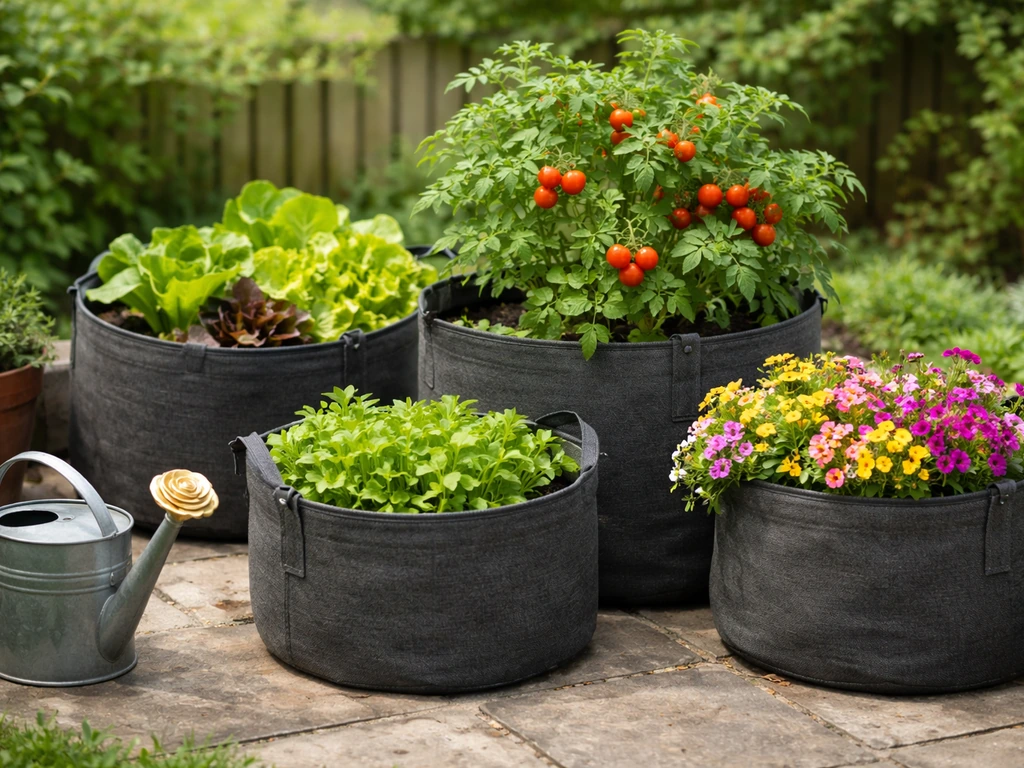
What to Grow in Grow Bags UK Best Crops and Tips
Best UK crops for fabric grow bags: vegetables, flowers, trees and mushrooms, with bag choice, setup, care and fixes.
How to Grow Plants in Grow Bags: Setup, Care, and Troubleshooting
Step-by-step guide to grow bags: choose the right size, prep soil, water and feed routines, and fix common plant problem
What to Grow in Hanging Grow Bags: Best Plant Picks
Best plants for hanging grow bags: beginner crops, herbs, vegetables, flowers, mushrooms, plus care tips for watering an