Fabric grow bags outperform traditional rigid containers on aeration and root health, but they dry out faster and wear out sooner. If you are growing vegetables on a patio or balcony, a quality fabric bag will almost always give you better roots and more consistent yields than a plastic pot of the same volume. For trees, large ornamentals, or anything sitting in hot direct sun all day, the choice gets more nuanced, and that is exactly what this guide works through.
Grow Bag vs Container: Which Is Best for Home Gardening
Marcus Holloway
18 Jul 2026
Quick head-to-head: fabric grow bags vs rigid containers
Before diving into the detail, here is a side-by-side comparison of the core performance factors most growers care about. Everything in the table is expanded in the sections below.
| Factor | Fabric Grow Bag | Rigid Container (Plastic/Nursery Tub) |
|---|---|---|
| Drainage | Excellent — water passes through the entire fabric wall, not just base holes | Adequate when holes are present; can waterlog if holes block |
| Aeration | High — oxygen reaches roots through the full bag surface | Low — gas exchange limited to soil surface and drainage holes |
| Root pruning | Automatic air-pruning at every point where roots meet fabric | Roots circle the smooth wall, causing girdling over time |
| Watering frequency | Higher — fabric evaporates moisture from all sides, faster drying | Lower — plastic retains moisture; watering typically less frequent |
| Heat management | Better — evaporative cooling reduces substrate temperature | Worse — dark plastic can raise pot-wall temps up to ~20°C above air temp in direct sun |
| Portability | Good when empty; handles help; can be folded flat for storage | Good for smaller pots; heavy when large; rigid shape takes up storage space |
| Durability | 1–5 seasons depending on fabric weight and UV exposure | Many years if not cracked; not foldable |
How fabric grow bags actually work
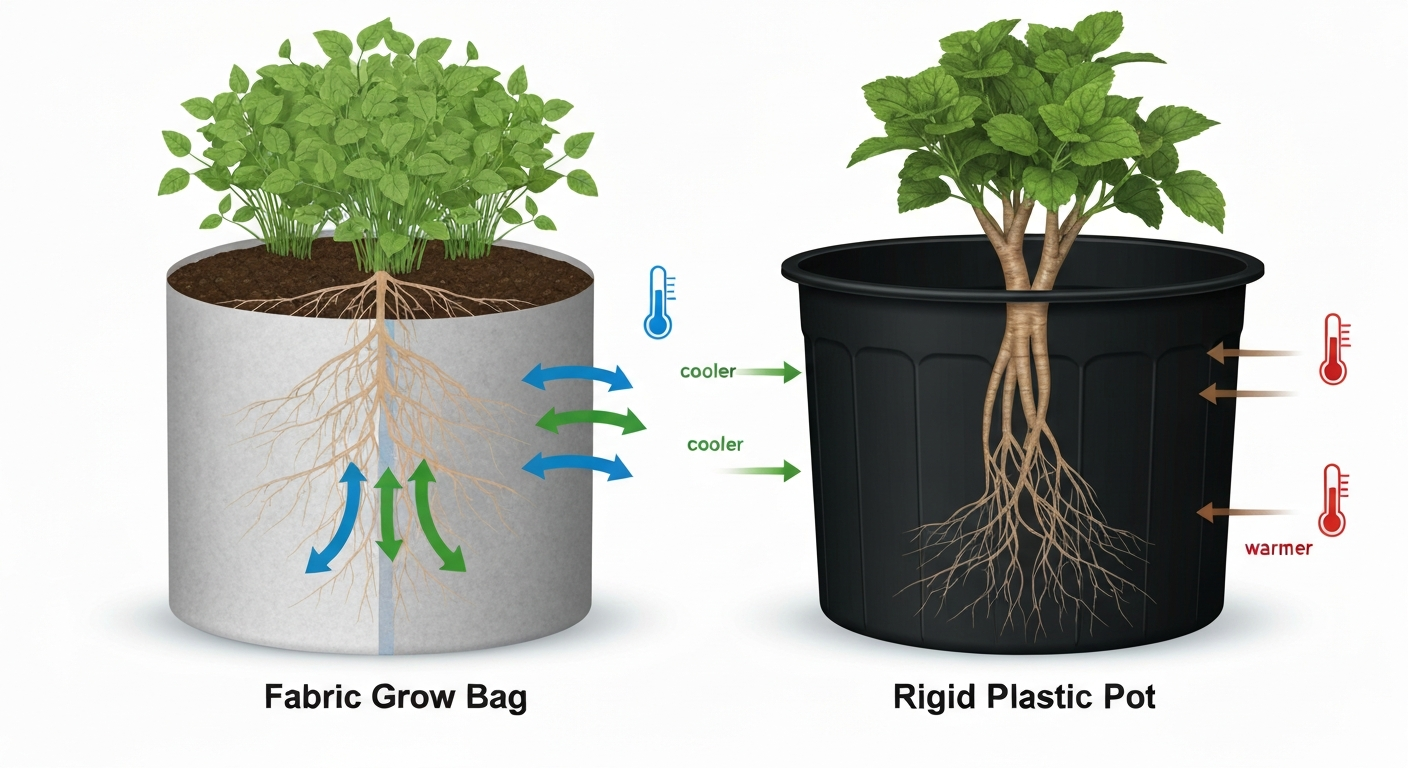
A fabric grow bag is made from a porous, non-woven material (more on the exact materials shortly) that allows both water and air to pass through the walls. That is the key difference from any rigid container. In a plastic pot, the only meaningful gas exchange happens at the soil surface and through the drainage holes at the base. In a fabric bag, the entire perimeter of the root zone is in contact with moving air.
That air contact does something specific and useful: when a root tip grows outward and reaches the bag wall, it encounters drier, aerated conditions. The root tip desiccates and stops elongating. The plant responds by branching laterally behind that stopped tip, producing multiple new feeder roots. This is air-pruning, and it happens passively, without any intervention. The result is a dense, fibrous root architecture rather than a few thick roots circling the container wall. Research published in Arboriculture and Urban Forestry (2018) on Chanticleer pear trees found that fabric-container-grown trees had measurably fewer circling roots and showed greater root spread beyond the original root ball two to three years after landscape planting, compared with trees grown in standard black plastic containers.
The moisture dynamics are a direct consequence of that same porosity. Water moves out through the fabric walls by evaporation and slow seepage, not just from the bottom. In hot or breezy conditions this evaporative loss cools the root zone, which is genuinely valuable. Dark plastic containers can raise substrate temperatures at the pot wall to roughly 20°C above air temperature under direct irradiance. A fabric bag moderates that heat passively. The tradeoff is that you will water more often than you would with a plastic pot of the same size, sometimes daily in summer.
Pros and cons in detail
Where fabric bags have a clear advantage
- Root health: air-pruning produces a branched, fibrous root system; no circling or girdling roots
- Drainage: virtually impossible to waterlog a fabric bag if you are using a decent potting mix, because the whole wall drains
- Aeration: oxygen-rich root zone supports aerobic microbial activity and reduces anaerobic rot
- Heat management: evaporative cooling through the fabric wall keeps the root zone cooler than dark plastic in summer sun
- Storage: emptiable and foldable flat — useful when you are rotating crops or gardening in small spaces
- Weight when empty: a 10-gallon fabric bag weighs ounces; a 10-gallon plastic pot does not
Where rigid containers have the edge
- Watering frequency: plastic holds moisture longer; fabric bags can need daily watering in hot weather
- Durability: a quality plastic nursery pot lasts many years; most fabric bags are rated for 1–5 seasons before UV degradation weakens the material
- Water-sensitive plants: succulents, cacti, or any plant that dislikes constant evaporation through the container wall are better in glazed ceramic or plastic
- Aquatic or semi-aquatic plants: obviously need a non-porous vessel
- Cost over very long periods: if a plastic pot lasts a decade, it may be cheaper per season than replacing fabric bags every few years
The honest middle ground
For most vegetable gardeners, the faster drying of fabric bags is manageable with drip irrigation or a consistent watering routine, and the root health and drainage benefits more than compensate. For permanent plantings or drought-prone climates where water use is a real constraint, a rigid pot or pot-in-pot setup reduces daily water demand meaningfully. The right choice depends on your specific crop, climate, and how much attention you can give to watering.
Grow bags vs air pots: how they compare
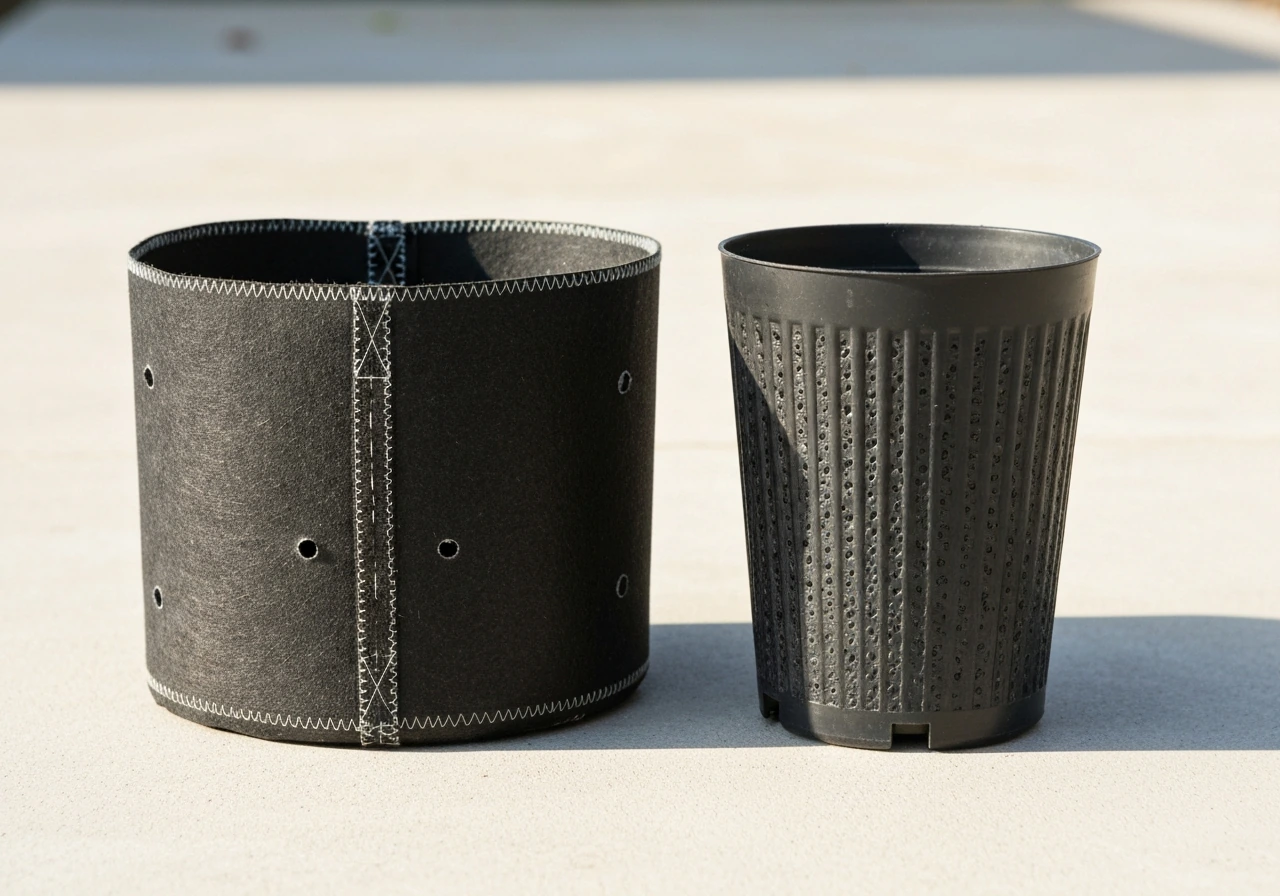
Air pots are rigid plastic containers with an inward-pointing, conical-studded wall full of open holes. Like fabric bags, they air-prune roots at the wall. The Air-Pot manufacturer cites Dutch and German trials showing their containers eliminated root circling and produced faster height and caliper growth compared with standard containers in those trials. So both systems solve the circling-root problem. The question is which suits your situation better.
| Factor | Fabric Grow Bag | Air Pot |
|---|---|---|
| Root pruning | Passive air-pruning across the entire fabric surface | Active air-pruning at cone-tip holes; geometry guides root tips outward |
| Drainage | Through the full fabric wall and base | Through side holes and base; excellent but not as total as fabric |
| Watering frequency | Highest — full surface evaporation | High, but typically slightly lower than fabric bags |
| Durability | 1–5 seasons (fabric weight dependent) | Many years; rigid plastic; reusable indefinitely with basic care |
| Cost | Low to moderate upfront; recurring replacement cost | Higher upfront; lower long-term cost due to longevity |
| Portability/storage | Folds flat; lightweight when empty | Rigid; does not compress; bulky to store |
| Typical best use | Annual vegetables, seasonal crops, propagation | Perennials, fruit trees, long-term container specimens, nursery production |
If you are growing tomatoes for one season, a fabric bag wins on price and convenience. If you are developing a container olive tree or a patio apple over several years, an air pot's durability and precise root architecture control make it worth the higher upfront cost. Both are significantly better for root health than a standard smooth-walled plastic pot. This comparison overlaps with a deeper look at grow bags vs air pots covered separately on this site, where both products are examined side by side in more detail.
What grow bags are actually made of
Not all fabric grow bags are made from the same material, and the difference matters for durability, drainage rates, and whether the bag is worth reusing. For a quick rundown of common substrates, see our section on what grow bags are made of. The four materials you will encounter most often are non-woven polypropylene, recycled PET felt, woven cotton blends, and general felt/fleece. Here is what each means in practice.
| Material | Description | Pros | Cons | Typical Lifespan |
|---|---|---|---|---|
| Non-woven polypropylene (PP) | Thermally bonded synthetic fibers; the most common grow bag material (Smart Pot is a well-known example) | Consistent pore size, good drainage, UV-stabilizable, phthalate-free options available | Not biodegradable; quality varies widely by GSM | 2–5+ seasons with UV treatment |
| Recycled PET felt | Made from recycled plastic bottles; Root Pouch uses this | Post-consumer recycled content; available in a wide weight range (90–260 g/m²) | Recycled quality can vary; lighter weights degrade faster | 1–5 seasons depending on fabric weight |
| Woven cotton/natural fiber blends | Natural-fiber bags sometimes marketed as biodegradable | Biodegradable; breathable | Degrade quickly (often one season); can harbor mold; inconsistent drainage | 1 season, sometimes less |
| Felt/fleece (generic) | Generic term for needle-punched or bonded synthetic fiber bags; most budget grow bags | Very low cost | Often thin, low GSM; poor UV resistance; seams fail early | 1–2 seasons at best |
Root Pouch publishes specific GSM (grams per square meter) ratings for each product line: their propagation line is 90 g/m² with an expected life of around 18–24 months; their Charcoal line is 150 g/m² (estimated 18–24 months); the Grey line is 250 g/m² and rated for 3–4 seasons; the Black line is 260 g/m² and rated for 4–5 seasons. That kind of transparency is exactly what you want from a manufacturer. When comparing budget bags, look for GSM ratings. Bags under 150 g/m² are thin and will not last more than a season or two in direct sun.
Construction quality beyond the fabric itself also matters. Check for stitched or reinforced handles rather than cut fabric loops, double-stitched or heat-sealed seams at the base, and UV stabilizer in the fiber rather than just a surface coating. A bag with handles that tear away in the first season is not much use for moving heavy substrate.
Color, UV stability, and heat: black vs tan grow bags
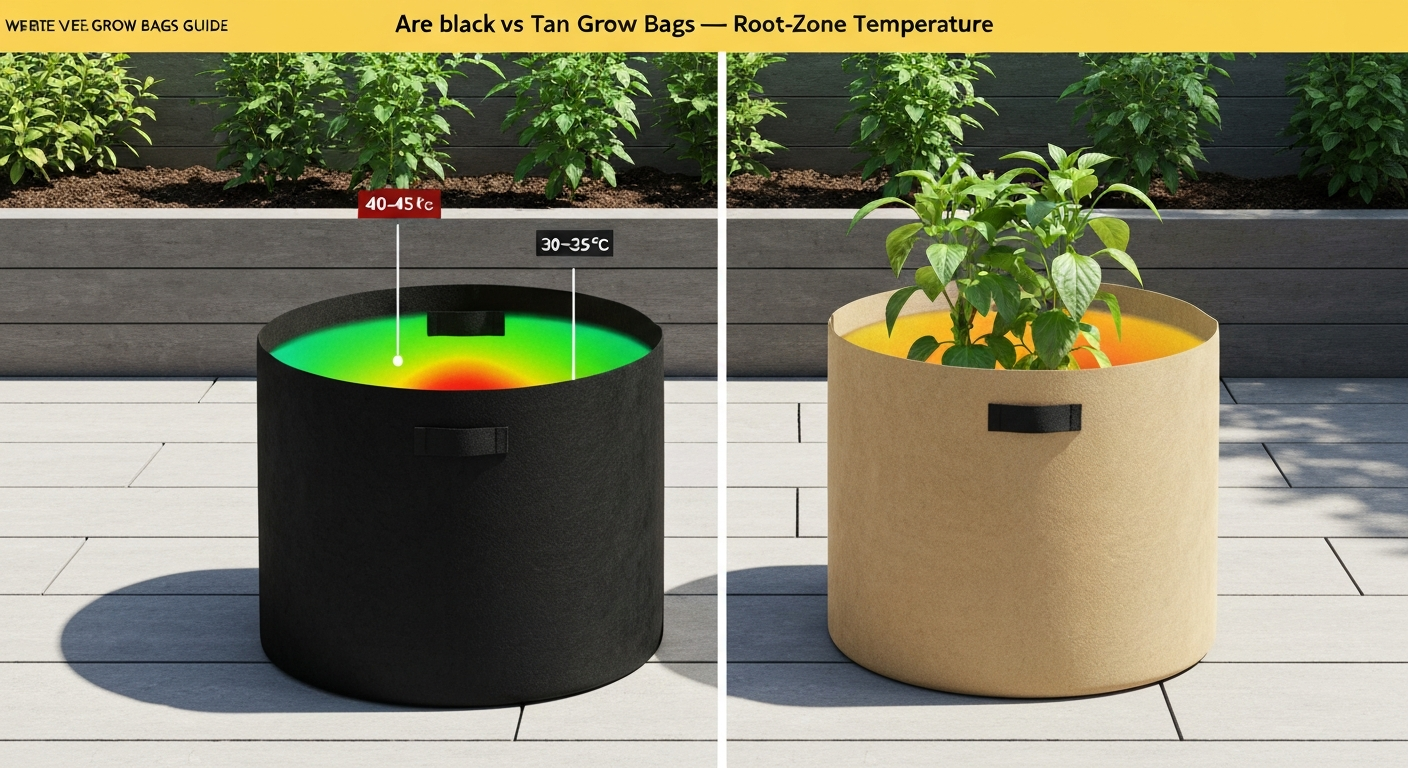
Black fabric bags absorb more solar radiation than lighter-colored bags. In a rigid plastic pot this would significantly overheat the root zone, but fabric bags partially offset that by evaporative cooling through the wall. Even so, the color choice is not irrelevant, especially in hot climates or for heat-sensitive crops.
Dark plastic containers in direct sun can raise substrate temperatures at the pot wall to approximately 20°C above air temperature. Fabric moderates this, but black fabric in full sun will still run warmer than tan or grey fabric in the same conditions. For cool-season crops like lettuce, spinach, or root vegetables, a lighter-colored bag reduces the risk of premature bolting or heat stress at the root zone. For warm-season crops in cool climates, a black bag can actually help by absorbing heat earlier in the season.
Recommendations by climate
- Hot climates (zones 9–13, high summer temperatures): choose tan, grey, or white bags for most crops; reserve black for short cool seasons or heat-loving crops like sweet potatoes
- Temperate climates (zones 6–8): either color works well for warm-season vegetables; black bags give a slight boost in early spring
- Cool/short-season climates (zones 3–5): black or dark bags help warm the root zone; a useful advantage for tomatoes and peppers starting in a short season
- UV stability matters more than color: whatever color you choose, confirm the bag has UV stabilizer in the fiber construction, not just a surface treatment — this is the primary factor in how long the bag lasts outdoors
The black vs tan decision is worth thinking through but is genuinely secondary to fabric weight and construction quality. A well-made tan bag will outlast a poorly made black bag by a season or more. The color and UV stability topic is explored in more depth elsewhere on this site if you want the full breakdown.
Choosing the right size for your crop
Container volume is one of the most common places growers go wrong, both directions. Too small and you are fighting the plant the entire season. Too large and you risk waterlogging, wasted substrate, and an unwieldy bag that is hard to move. The recommendations below are based on university extension guidance and widely validated production experience. UNH Cooperative Extension recommends about 5 gallons minimum for a single tomato plant UNH Cooperative Extension recommends about 5 gallons minimum for a single tomato plant..
| Crop | Minimum Volume | Recommended Volume | Notes |
|---|---|---|---|
| Cherry/patio tomatoes | 1–2 gallons | 3–5 gallons | Compact varieties can work in smaller bags; indeterminate types need staking |
| Standard/beefsteak tomatoes | 5 gallons | 7–10 gallons | 5 gallons is the commonly cited minimum; larger bags reduce watering stress in peak summer |
| Peppers (all types) | 2–3 gallons | 3–5 gallons | Peppers tolerate slightly smaller volumes than tomatoes |
| Lettuce and leafy greens | 1 gallon | 1–3 gallons | Shallow-rooted; a wide, low bag works well; harvest outer leaves to extend productivity |
| Herbs | 0.5–1 gallon | 1–3 gallons | Most herbs do not need deep root space; basil benefits from larger volumes |
| Potatoes | 7–10 gallons | 10–15 gallon tall bag | Depth matters for hilling; purpose-made tall potato bags allow progressive filling |
| Cucumbers | 5 gallons | 5–7 gallons | Need vertical support; position bag near a trellis |
| Strawberries | 1–2 gallons per plant | Strawberry pocket bags (multi-plant) | Side-pocket bags allow 6–12 plants in a compact vertical footprint |
| Mushrooms | Substrate-specific polypropylene bags | Autoclavable PP bags with filter patches | These are not horticultural fabric bags — see note below |
| Flowers and ornamentals | 1–3 gallons for annuals | 5–7 gallons for large perennials | Most annual flowers thrive in 2–3 gallons with regular feeding |
| Dwarf fruit trees and large shrubs | 15–25 gallons minimum | 25–45 gallons | University extension often recommends 25–30+ gallons for dwarf potted fruit trees; root system needs space |
A note on mushroom grow bags: the polypropylene bags used for mushroom substrate colonization are a completely different product from horticultural fabric grow bags. Mushroom bags are clear or translucent, autoclavable, fitted with microporous filter patches rated around 0.2–0.5 microns, and used for sterile substrate colonization under laboratory or semi-sterile conditions. If you are growing mushrooms, you need that specific type of bag, not a garden grow bag.
Practical planting and use
Filling and potting mix
Never fill a fabric grow bag with garden soil. Heavy soil compacts inside a bag, restricts drainage, and defeats the whole point of the porous container. Use a peat-free or peat-based potting mix (whichever you prefer), combined with perlite at around 20–30% by volume for additional drainage and aeration. Coir-based mixes work well and hold moisture slightly better than pure perlite-heavy mixes, which is a practical advantage in fabric bags that dry out quickly. Fill to about 2 inches below the rim to prevent soil washing out when watering.
Positioning and support
Place fabric bags on a raised surface (wooden slats, a grow bag tray, or bricks) rather than directly on solid concrete or decking. Solid surfaces block air access to the base and can stain paving. Raised placement also improves bottom drainage and keeps the bag wall drier, extending its life. For vining crops like tomatoes or cucumbers, position the bag directly next to a trellis, fence, or cage before planting. Moving a 10-gallon bag full of wet substrate is unpleasant and risks tearing the handles.
Specialty setups: potato bags and strawberry pockets
Tall potato grow bags (typically 10–15 gallons, 18–24 inches deep) are purpose-designed to allow the progressive hilling technique: fill the bag 4–6 inches deep with mix, plant seed potatoes, then add more mix as shoots emerge, repeating until the bag is full. This maximizes the stolon length and potato yield per plant. Some bags have a viewing flap or roll-down side to check tuber development without disturbing the plant. Strawberry pocket bags are wide-format bags with pre-cut side pockets that hold individual plants; they work well vertically on a fence or wall and make efficient use of a small balcony.
Practical care and troubleshooting
Watering frequency
Fabric bags dry out faster than rigid containers, and that drying rate is affected by bag size, ambient temperature, wind, sun exposure, and what you have planted. In hot, dry, or breezy weather, a 5-gallon bag with a tomato plant at peak growth can need watering once or even twice daily. A 15-gallon bag with a dwarf fruit tree in a sheltered spot may only need watering every 2–3 days. The best approach is the finger test: push your finger 2–3 inches into the mix. If it is dry at that depth, water thoroughly until you see water seeping from the base and sides of the bag. Penn State Extension and others recommend watering deeply and allowing the top layer to approach dryness before the next watering, rather than light frequent wetting that keeps only the surface moist.
Drip irrigation pays for itself quickly when you have more than three or four fabric bags. A simple timer-controlled drip system delivering measured volumes removes the daily guesswork and is especially useful in summer when you are away for a day or two. Soil moisture probes are a worthwhile investment for larger bags or expensive crops.
Feeding and fertilizer
Container plants, including those in fabric bags, need regular fertilization. Nutrients leach out of porous containers faster than they would from garden beds, so the soil quickly runs low even if you started with a rich mix. NC State Extension and other university sources recommend using a controlled-release (slow-release) fertilizer incorporated at planting, supplemented with periodic water-soluble feeding during the season. Sources such as Plants Grown in Containers, NC State Extension (Extension Gardener Handbook, chapter) recommend using a controlled‑release fertilizer at planting plus periodic water‑soluble feeding to replace nutrients leached from container media Sources such as Plants Grown in Containers — NC State Extension (Extension Gardener Handbook, chapter) recommend using a controlled‑release fertilizer at planting plus periodic water‑soluble feeding to replace nutrients leached from container media.. A balanced slow-release granular fertilizer dug into the top inch of mix at the start of the season covers the baseline. Liquid feeds (balanced or high-potassium during fruiting) every 1–2 weeks top up what is leached. Research on controlled-release fertilizers in container production confirms they reduce nitrogen leaching compared with frequent soluble applications, which is both a cost and an environmental benefit.
Pests and diseases
Fabric bags generally reduce the risk of overwatering-related root rot compared with plastic pots, which is one of the most common container-growing disease problems. The aerated root zone does not suit anaerobic pathogens like Phytophthora as well as a waterlogged plastic pot does. That said, fungus gnats love organic potting mix regardless of container type, and the moister surface of a well-watered fabric bag can attract them. Letting the top inch of mix dry between waterings, and using yellow sticky traps, controls gnat populations effectively. Aphids, whitefly, and spider mites attack the plant rather than the container; treat these the same way you would in any container garden.
Cleaning, reusing, and expected lifespan
At the end of the season, empty the bag completely, shake out as much old soil as possible, and turn it inside out to remove root material from the fabric. Soak in a dilute bleach solution (1 part bleach to 9 parts water) for 30 minutes to sanitize, then rinse thoroughly and allow to dry fully before storing. Partially dry bags stored in a closed space grow mold quickly. Fold flat and store in a cool, dry location out of UV light, UV degradation is the primary cause of fabric failure, so off-season storage indoors extends life significantly.
Expected lifespan depends heavily on fabric weight, UV stabilization, and how carefully you handle the bags. As a practical guide: thin bags under 150 g/m² typically last 1–2 seasons; mid-weight bags at 200–250 g/m² last 3–4 seasons; heavier bags at 260 g/m² or above from quality manufacturers can reach 4–5 seasons with proper care and off-season storage. A bag showing torn seams, fraying handles, or visible UV breakdown (the fabric becomes brittle and chalky) should be retired. Old bags can often be repurposed as weed suppressant or drainage liner before final disposal.
Cost and sustainability
A decent 5-gallon fabric grow bag from a quality manufacturer costs roughly $3–8 depending on brand and where you buy. For buying guidance and top-rated options, see our grow bags best recommendations. Budget bags from bulk sellers can be under $2 each in packs, but they typically last only one season, so the per-season cost is not as low as it looks. A 5-gallon plastic nursery pot of similar quality costs a similar amount upfront but can last a decade or more with no maintenance. On a pure per-season cost basis, rigid plastic still wins over time, but that calculation ignores the root-health benefit and the practical advantages of foldable, lightweight storage.
Sustainability is genuinely mixed. Non-woven polypropylene is a synthetic polymer and is not curbside-recyclable in most regions, though some manufacturers have take-back or recycling programs. Recycled PET bags use post-consumer recycled plastic, which is a meaningful improvement in embodied carbon compared with virgin polypropylene. Natural fiber bags biodegrade but rarely last more than a season and often contain synthetic binder fibers that do not fully break down. If sustainability is a priority, look for bags made from recycled content with documented recycling programs, and commit to getting the maximum service life out of each bag through proper cleaning and storage.
Buying checklist: what to look for
When you are comparing grow bags before buying, run through these criteria to filter out the products that will frustrate you after one season.
- Fabric weight (GSM): aim for 200 g/m² or above for multi-season use; 150 g/m² is acceptable for seasonal propagation bags
- Material: non-woven polypropylene or recycled PET felt are the most reliable; confirm the material is specified, not just labeled 'fabric'
- UV stabilization: the product listing or manufacturer spec should confirm UV inhibitors are in the fiber, not just a surface coating
- Handles: stitched and reinforced, not cut from the bag fabric; test by checking whether handles are a separate sewn panel
- Seam construction: look for double-stitched or heat-sealed seams at the base; this is where cheap bags fail first under a full load of wet substrate
- Drainage confirmation: check that the base is the same porous fabric as the walls, not a sealed base with small holes
- Size and shape match to your crop: use the volume recommendations above; do not buy one-size bags for a mixed planting setup
- Warranty or rated service life: quality manufacturers publish expected service life by product line; anonymous budget bags with no spec sheet are a warning sign
Quick decision flow
- Growing annual vegetables or seasonal crops for 1–2 seasons? Fabric grow bag is the practical choice
- Growing perennial plants, trees, or anything you want in the same container for 3+ years? Consider air pots or a high-GSM fabric bag with confirmed UV resistance
- Limited on water or away frequently? Choose a rigid pot or add drip irrigation to fabric bags
- Hot climate, heat-sensitive crops? Choose tan or grey fabric bags and position out of all-day direct sun
- Short cool season, heat-loving crops? Black fabric bags absorb heat usefully in spring
- Prioritizing sustainability? Choose recycled PET bags and commit to cleaning and reusing each bag for its full rated life
Sample setups that work well
Balcony tomatoes
Use a 7–10 gallon tan or grey fabric bag positioned against a railing or trellis in full sun. Fill with a peat-free or coir-based mix plus 20–25% perlite. Mix in a balanced slow-release granular fertilizer at planting. Plant one indeterminate variety per bag, stake or tie to the trellis early, and water daily (sometimes twice daily at peak summer). Supplement with a weekly high-potassium liquid feed once flowering starts. Expect to water more than you would with a plastic pot, but root health will be visibly better if you examine the roots at season end.
Patio potatoes
A 10–15 gallon tall potato bag in a dark color (to absorb heat early in the season) works best. Start filling with 6 inches of mix, place two or three seed potatoes on top, cover with 4 inches of mix, and hill progressively as shoots emerge. The progressive filling technique maximizes the depth available for stolons. Water consistently throughout and feed with a balanced fertilizer until the foliage starts to yellow, then stop watering and harvest 1–2 weeks later. Fold the empty bag flat and store indoors.
Mushroom substrate bags
This is a separate category from horticultural grow bags. For oyster mushrooms, lion's mane, or similar species, you need clear autoclavable polypropylene bags with microporous filter patches, not garden fabric bags. Sterilize your substrate (usually hardwood sawdust supplemented with bran) in the bag using a pressure cooker or autoclave, cool to room temperature under sterile conditions, inoculate with grain spawn using sterile technique, and colonize in a clean area away from contaminants. These bags are single-use for substrate colonization.
Container fruit trees
A dwarf apple, fig, or citrus in a 25–30 gallon fabric bag or air pot is a long-term investment. Use a high-GSM fabric bag (260 g/m² rated for 4–5 seasons) or an air pot for permanence. A well-draining, slightly acidic potting mix with controlled-release fertilizer provides the baseline nutrition; supplement with a fruit-tree-specific liquid feed during the growing season. Position on castors so the heavy container can be moved indoors or under cover in cold snaps. Check and repot every 3–5 years as roots fill the container.
Troubleshooting quick reference
| Problem | Likely Cause | Quick Fix |
|---|---|---|
| Soil stays wet/soggy | Dense or peat-heavy mix with poor structure; bag sitting on solid surface blocking base drainage | Repot with a mix containing 20–30% perlite; raise bag on slats or a rack |
| Bag drying out within hours in summer | Small bag volume, high ambient temperature, wind exposure, or heavy crop transpiration | Move to a partially shaded location during peak afternoon heat; add drip irrigation; mulch the soil surface inside the bag |
| Roots visibly circling or coming through the bag wall | Bag has been in use too long without repotting; root zone is fully saturated with roots | Upsize to a larger bag; trim roots showing through the wall before repotting; plant was likely constrained for some time |
| Bag overheating (soil hot to touch) | Black bag in full direct afternoon sun in a hot climate | Switch to a tan or grey bag; shade the bag in afternoon; consider a light-colored outer sleeve |
| Fabric tearing or seams failing | Thin GSM bag, UV degradation, or handles overloaded when moving a full bag | Replace with a higher-GSM bag; move bags when empty and refill in place; store off-season away from UV |
| White or grey crust on bag exterior | Mineral deposits from hard water or fertilizer salts wicking through the fabric | Soak and rinse with water; reduce fertilizer concentration; not structurally harmful but indicates high salt load in the mix |
| Mold on bag surface | Consistent moisture on the fabric exterior without adequate airflow | Improve airflow around the bag; reduce watering slightly; a small amount of surface mold is cosmetic and does not harm roots |
FAQ
What are fabric grow bags and how do they differ from traditional rigid containers and air pots?
Fabric grow bags are porous, breathable containers usually made from non‑woven polypropylene or recycled plastics (and some from natural fibers). They let water pass and air‑prune roots at the fabric surface. Traditional rigid containers (plastic pots, nursery tubs) are smooth‑walled and non‑porous, which can encourage root circling and retain more moisture and heat. Air pots are rigid plastic containers with internal ribs and many holes or tapered cells that force roots to branch and avoid circling; they achieve air‑pruning with a rigid structure rather than a full‑surface fabric. All three reduce circling compared with smooth black pots, but they differ in thermal behavior, water loss, portability and handling.
What are the main pros and cons of fabric grow bags compared with rigid pots?
Pros: better aeration and oxygen exchange at the perimeter, consistent air‑pruning that reduces circling and encourages fibrous lateral roots, cooler root zones in sun due to evaporative cooling, lighter and easy to store, inexpensive for many sizes. Cons: higher evapotranspiration so they usually need more frequent watering, lower physical rigidity (can deform under media), shorter service life depending on fabric GSM and UV exposure, can leak fine media if not lined, and don’t suit sterile mushroom production (see separate note). Net effect: fabric bags favor healthier root architecture but require more attentive irrigation and may need replacement sooner than thick rigid pots.
How do fabric grow bags compare with Air‑Pot style containers?
Both fabric pots and Air‑Pots reduce root circling and promote lateral branching through air‑pruning. Air‑Pots (rigid with holes/cells) often produce similar root architecture benefits and in some production trials showed improved above‑ground growth metrics. Differences: Air‑Pots are rigid and hold shape, usually need less frequent irrigation than thin fabric, and are more durable but more expensive. Fabric pots are lighter, stowable, and often cheaper; they offer whole‑surface gas exchange rather than discrete holes. Choice depends on budget, desired durability, irrigation regime and handling needs.
What are common materials used for fabric grow bags and what are the evidence‑based pros and cons of each?
Common materials: non‑woven polypropylene geotextile (most commercial brands, e.g., Smart Pot), laminated polypropylene blends, and recycled plastic felt (Root Pouch lines) or natural fiber blends. Lightweight lines (≈90 g/m²) are inexpensive but wear faster; midweights (150–260 g/m²) balance durability and breathability—manufacturers report service life from ~1–5 seasons depending on GSM and UV stabilizers. Pros of synthetic non‑woven: durable, consistent porosity, UV‑stabilized options exist. Pros of recycled fabric: lower embodied plastic, sometimes thicker. Cons: all synthetic fabrics degrade under UV and can eventually leak microplastics if extremely worn; natural fibers decompose faster and are less durable.
Does grow bag color (black vs tan/grey) matter? Which should I choose?
Yes—color affects heat absorption and light reflectance. Dark (black) fabric absorbs more radiation and can warm the substrate under strong sun; fabric still allows evaporative cooling so it’s usually cooler than black plastic pots but warmer than light colors. Tan/grey or reflective/light colors reduce soil‑heating risk and can be advantageous in hot climates or for heat‑sensitive crops. Choose light/reflective colors if you garden in hot full sun or grow heat‑sensitive plants; black or charcoal can be fine in temperate climates or for cool‑season crops.
What sizes of fabric grow bags should I buy for common crops (vegetables, flowers, small trees)?
Match volume/depth to crop needs: - Herbs/leafy greens: 1–3 gallons (6–12 in depth) - Bush beans/lettuce/compact herbs: 2–5 gallons - Peppers/eggplant/determinate tomatoes: 5–10 gallons (12–16 in depth) - Indeterminate tomatoes, large pepper/tomato varieties: 10–20 gallons (14–20 in depth) - Patio/cherry tomato varieties: 1–5 gallons depending on cultivar - Small dwarf fruit trees or large shrubs: 25–30+ gallons and 18–24 in minimum root depth. These match common extension guidance; err on the larger side for longer seasons or big‑fruited crops.
Next Articles
Grow Bags Best Guide: Choosing, Sizing, Care & Top Picks
Grow bags best: expert guide to choosing, sizing, care, and buying checklist for home gardeners.
Are Black or Tan Grow Bags Better? Choosing the Right Color
Black vs tan grow bags: clear advice on heat, UV, crops & climate + buying checklist and care tips.
Grow Bags vs Air Pots: Which Container to Choose?
Compare grow bags and air pots for root health, watering, yield, and plant fit, with clear buying and care guidance.