Fabric grow bags are worth it for most home growers. They actively air-prune roots, drain faster than plastic pots, and produce healthier root architecture that translates to better yields, especially for tomatoes, potatoes, peppers and small trees. For a 10-gallon bag you're looking at roughly $13 to $22 depending on brand and pack size, and a quality polyester bag holds up for three to five seasons. If you've had root-bound plants, waterlogged containers or poor tomato yields in standard pots, switching to fabric bags is one of the most practical upgrades you can make.
Grow Bags Best Guide: Choosing, Sizing, Care & Top Picks
Marcus Holloway
16 Jul 2026
What grow bags actually are and what people grow in them
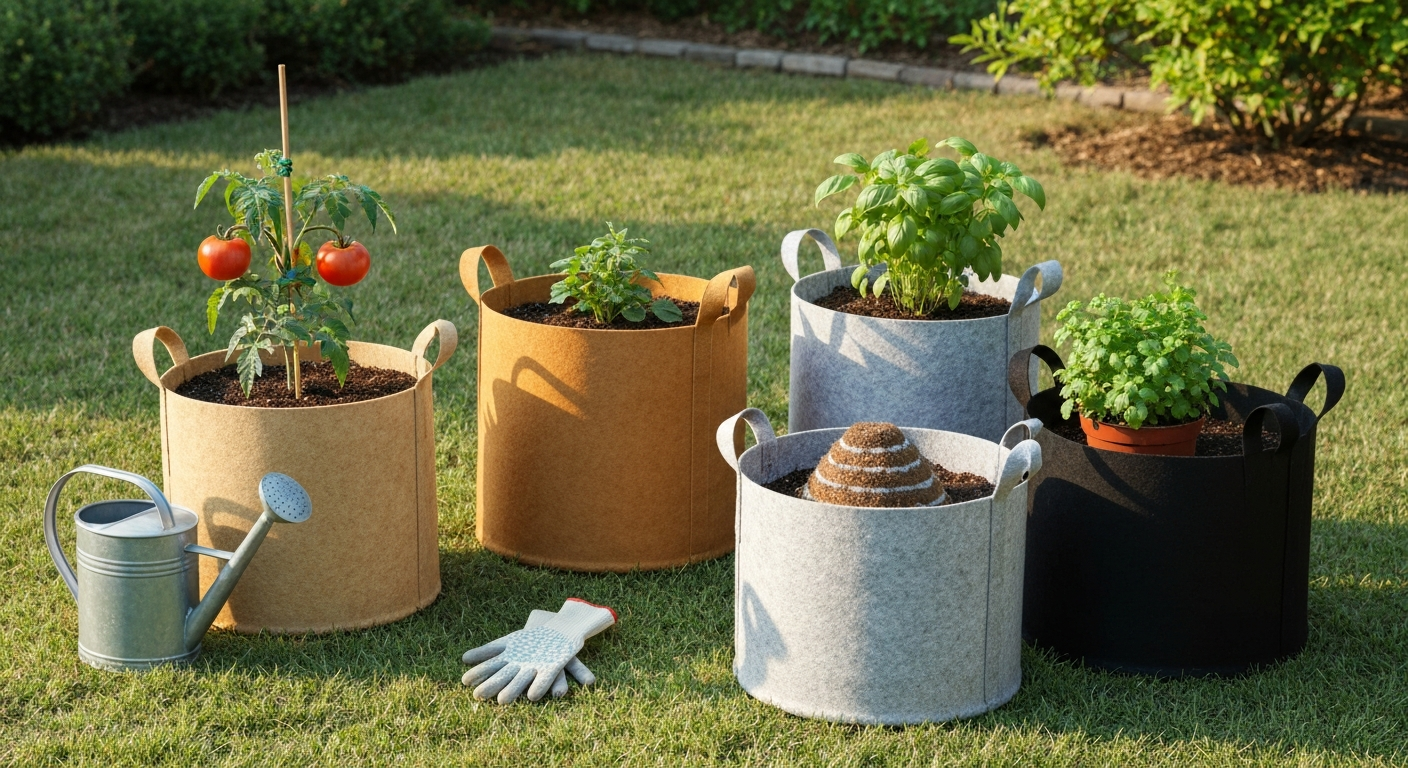
A grow bag is a flexible, breathable container made from fabric rather than rigid plastic or ceramic. The fabric wall allows air to pass through the root zone, which triggers a process called air pruning: when a root tip reaches the container wall and hits dry air, the tip stops elongating and the plant responds by branching laterally and producing more fine, fibrous roots instead of the circling, girdling roots you get in a smooth plastic pot. That difference in root architecture is the core reason grow bags produce measurably better results in trials comparing fabric containers with standard nursery pots.
Home growers use fabric bags across a wide range of crops and situations. Vegetables are the most common use: tomatoes, peppers, potatoes, carrots, lettuce, herbs and cucumbers all do well. Potato growers particularly love fabric bags because you can start with a few inches of medium, then hill up in stages by adding more mix as the plant grows, which increases tuber set and makes harvest as easy as tipping the bag over. Mushroom cultivators use thick fabric bags as low-cost sterilizable substrate containers for oyster, shiitake and other species. Flowers, ornamentals and even small fruit trees can be grown or established in fabric bags, and peer-reviewed work on containerized ornamental trees confirms that plants moved from fabric containers to the landscape show more root growth outside the original root ball and fewer circling roots compared with plastic-grown stock.
How grow bags are made: fabric types and construction
Most grow bags you'll encounter fall into one of three material categories: nonwoven spunbond fabric (polypropylene or polyester), woven geotextile fabric, or a felt-like needlepunched nonwoven. Each is made differently and performs differently in the garden.
Nonwoven spunbond fabric
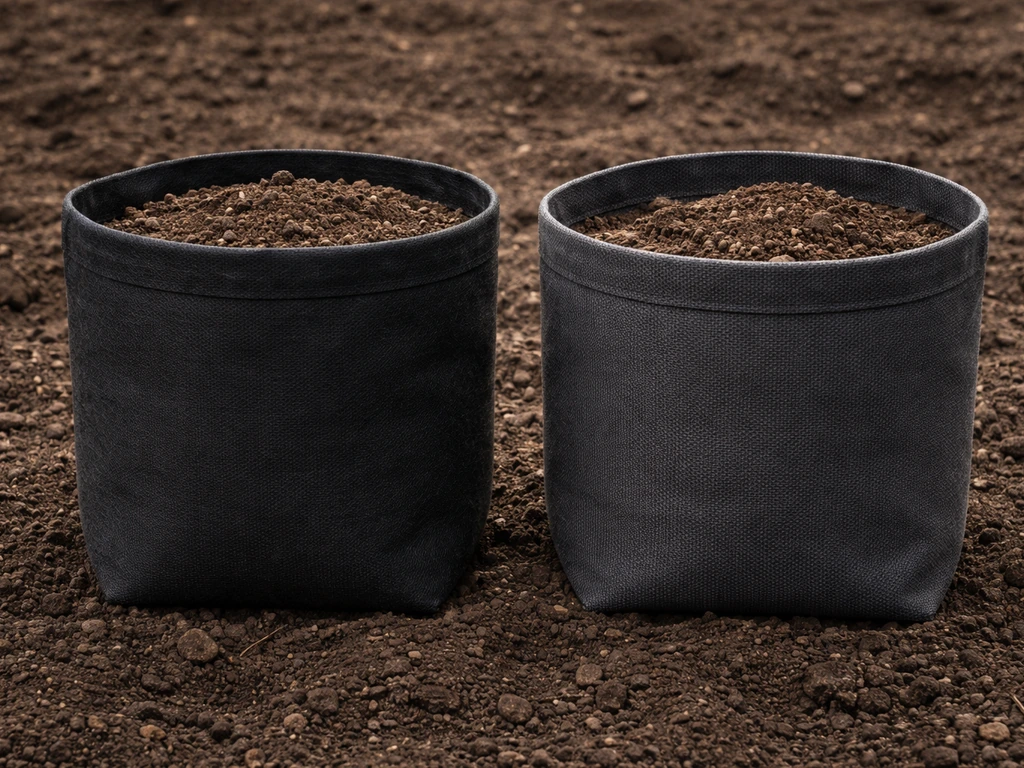
Spunbond fabric is made by bonding or needle-punching synthetic fibers together without weaving. Most cheap grow bags you'll find in multipacks use polypropylene (PP) spunbond. Smart Pot, one of the original fabric pot brands, uses a thicker nonwoven felt. Root Pouch uses a blend that includes recycled PET (polyester) fibers. The difference matters for longevity: PET nonwovens with UV stabilizers retain significantly more tensile strength after prolonged outdoor UV exposure than untreated PP nonwovens. If you're buying a bag you want to reuse for four or five seasons, look for polyester construction or a brand that explicitly lists UV stabilizers in its specs.
Woven geotextile fabric
Woven bags use interlaced fabric threads, similar to landscape fabric. They tend to be stiffer, hold their shape better, and can sometimes be rated for higher load weights. The trade-off is that the weave pattern creates larger and more uniform pore sizes, which can mean faster drainage but slightly less even air pruning across the whole surface compared with the more diffuse porosity of a nonwoven. For root crops and heavy soil mixes, the structural rigidity of woven bags is a practical advantage.
Felt and needlepunched nonwovens
Thick felt bags are what most people picture when they think of a grow bag. They have an almost uniform porosity across the whole surface, which produces consistent air pruning. Fabric GSM (grams per square meter) is a rough guide to thickness and durability: budget bags often run 80–150 GSM, while heavier-duty felt bags used by serious growers or nurseries run 300 GSM and above. Higher GSM generally means better structural integrity and longer lifespan, but it also reduces breathability slightly. For most vegetables a 150–200 GSM bag hits a good balance.
Plastic-fabric blends and laminated designs
Some specialty bags, including mushroom grow bags, use polypropylene plastic bags that are filter-patch equipped rather than fully breathable fabric. These are designed for sterilization and inoculation workflows rather than soil growing. Breathable laminate materials like Tyvek-style composites have measurable moisture vapor transmission rates (MVTR) in the range of 800 to 2,000 grams per square meter per 24 hours depending on construction, which is a real engineering metric for comparing how much moisture vapor a fabric moves. For practical home growing purposes, the key takeaway is that more breathable fabrics dry out faster and prune roots more aggressively.
Black vs tan grow bags: how color affects root-zone temperature
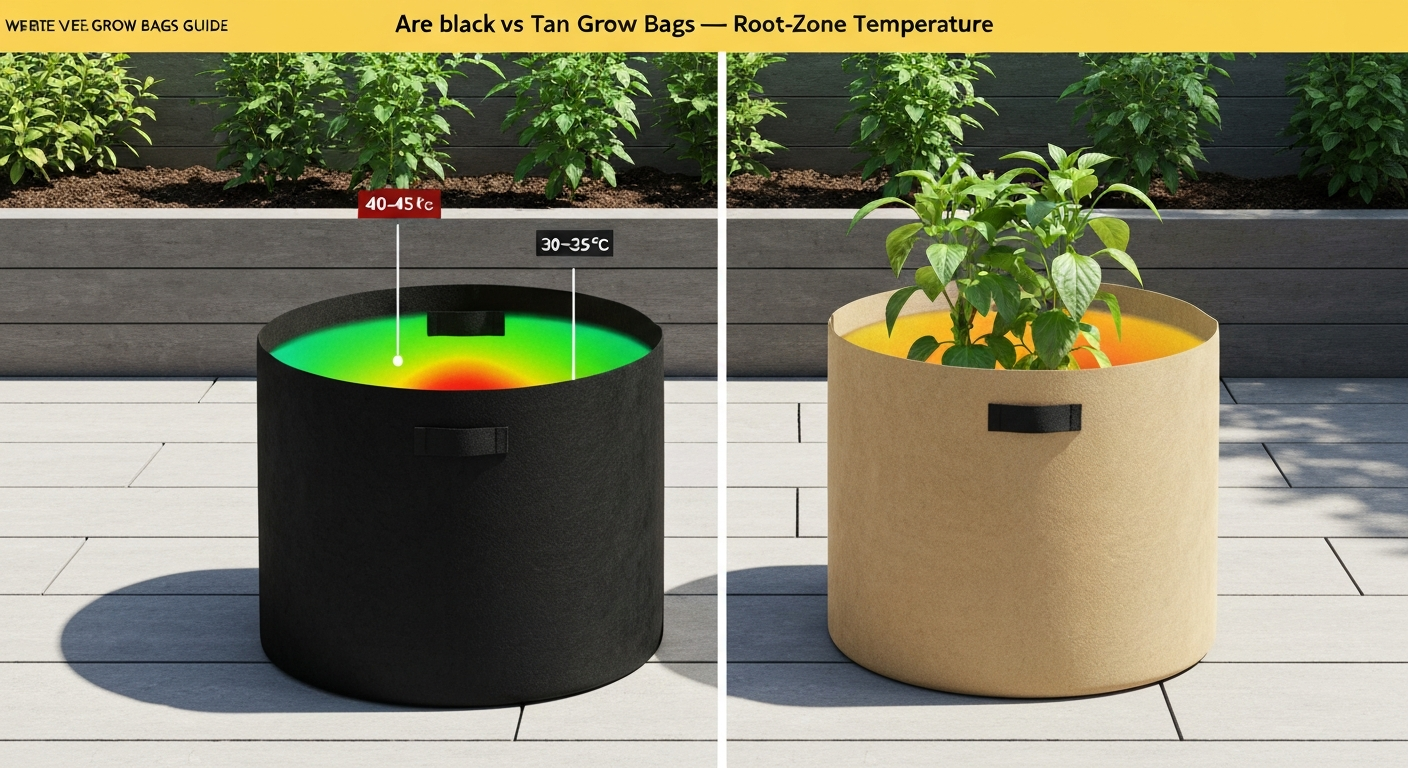
This is not a trivial question, especially if you grow in a hot climate or on a dark patio surface. Controlled field measurements have found maximum root-zone temperatures in black solid containers reaching 46 to 51°C in full sun, while lighter or air-pruning containers measured lower maxima around 41 to 43°C. Those numbers matter because most vegetable roots experience heat stress above 35°C and root death above 45°C. Fabric bags moderate temperature somewhat compared with solid black plastic pots because the breathable wall allows some evaporative cooling, but color still makes a measurable difference.
Tan, gray or light-colored fabric bags reflect more solar radiation and keep the root zone cooler in summer, which is meaningful in USDA zones 7 and warmer or anywhere bags sit on hot concrete. Black bags absorb more heat, which can actually benefit cool-season crops or early-spring planting because warmer soil speeds germination and early root development. If you're growing tomatoes and peppers through a hot summer in a southern garden, tan or light-colored bags are the better call. If you're starting cool-season greens in spring or growing in a northern climate, black is fine and the extra warmth is a bonus. The color question is discussed in more depth elsewhere on this site for growers who want to dig into the specifics. For a direct comparison answering whether black or tan grow bags are better, see our guide titled "Are black or tan grow bags better" for climate-specific recommendations.
How material and construction affect root pruning and durability
The root-pruning effect is well documented in peer-reviewed research. A study on Chanticleer pear trees grown in Smart Pot and Root Pouch fabric containers found more root growth outside the original root ball and fewer circling or girdling roots after two to three years in the landscape compared with plastic-grown stock. A separate study on Miss Kim lilac showed fabric containers produced more fibrous, small-diameter roots distributed throughout the substrate versus the circling patterns typical of smooth-walled pots. Comparative nursery trials across multiple air-pruning container types (air pots, Root Pouch, Smart Pot, light-wall pots) consistently show reduced circling and increased fine-root density relative to standard nursery containers.
Thicker fabric and finer pore structures produce more even air pruning across the whole container wall. Very thin or coarsely woven bags may prune roots unevenly, leaving sections of the root ball underpruned. For trees and long-term container plants, heavier fabric is worth the investment precisely because it delivers more consistent pruning. For annual vegetables grown over a single season, a lighter bag is perfectly adequate. Durability, meanwhile, comes down to UV resistance (polyester outlasts untreated polypropylene), seam and handle construction (double stitching and reinforced handle attachment points prevent failure under load), and whether the base is bound or boxed rather than just folded and stitched.
Durability, UV resistance and how long grow bags actually last
Smart Pot claims a usable life of roughly three to five years depending on UV exposure and care. Root Pouch, which uses recycled PET fiber, makes similar claims. In my experience those estimates are realistic for quality bags stored out of direct sun between seasons. Budget PP bags left outdoors year-round often start degrading visibly at two seasons, with seams failing before the fabric itself. Polyester spunbond fabrics with UV stabilizers retain far more tensile strength after thousands of hours of accelerated UV exposure than untreated PP, which is why buying from a brand that specifies PET or UV-stabilized construction is worth a small price premium if you plan to reuse bags.
Sustainability is a reasonable concern with any synthetic container. A fabric bag that lasts five seasons and replaces five single-use plastic pots is a net improvement. Recycled-content bags from brands like Root Pouch reduce virgin plastic inputs further. At the end of life, most nonwoven PP or PET fabric bags are not curbside recyclable but some brands offer take-back or recycling programs. Rinsing bags, drying them thoroughly and storing them flat or rolled between seasons meaningfully extends their life.
Grow bags vs containers and air pots: a quick comparison
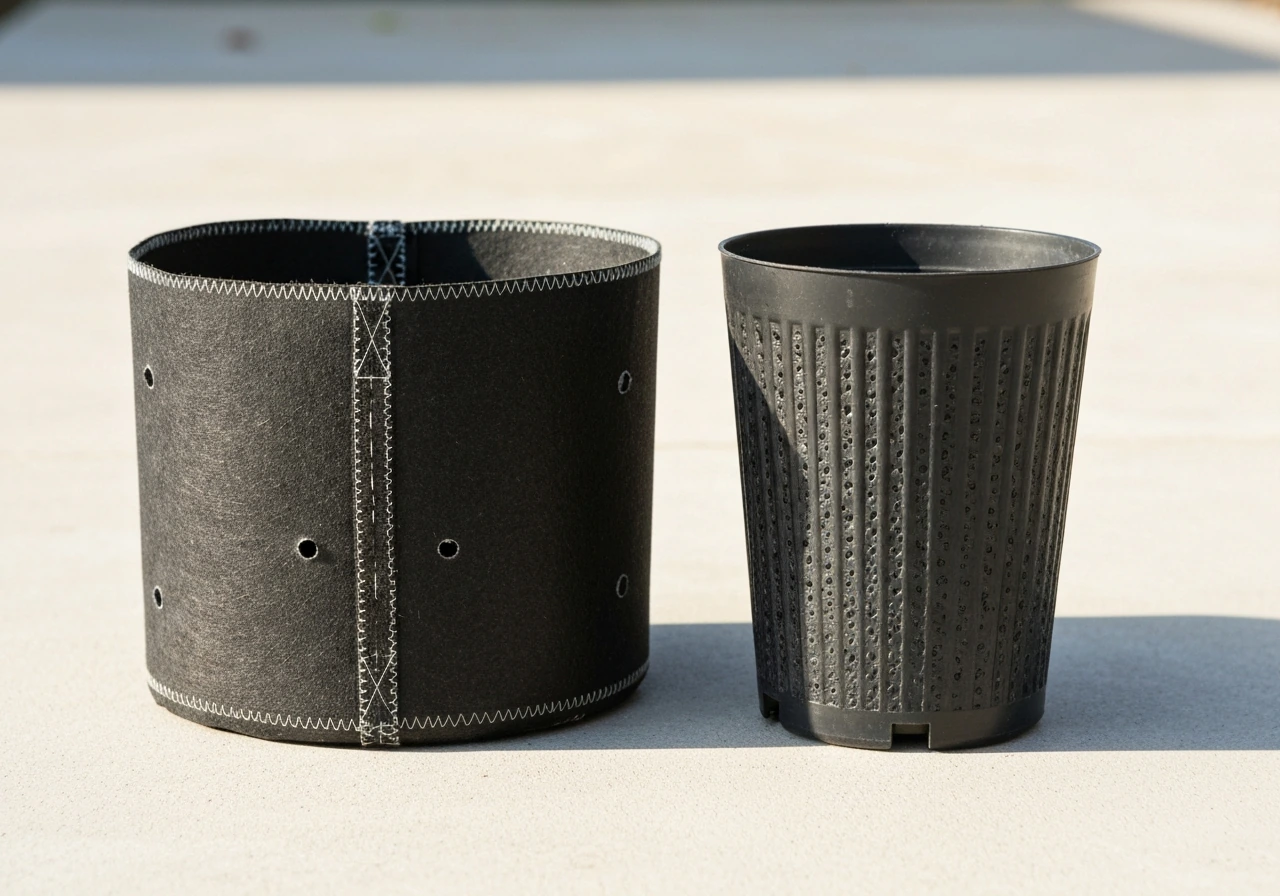
It helps to see grow bags in context with the alternatives you're probably already using or considering. For a direct comparison of options, see our grow bag vs container guide for pros, cons and use cases. Rigid plastic containers are cheap and widely available but produce root circling in long-term plantings and provide no air pruning. Air pots use a molded plastic wall with inward-pointing holes and cones to guide and prune roots; they produce excellent root architecture but are bulkier, harder to store and generally more expensive per unit. Fabric grow bags sit in the middle: good air pruning, compact and lightweight storage, moderate price, but they dry out faster and have a finite lifespan.
| Feature | Plastic Container | Fabric Grow Bag | Air Pot |
|---|---|---|---|
| Root pruning | None (root circling common) | Good (passive air pruning) | Excellent (guided air pruning) |
| Drainage | Limited to drain holes | Full-surface drainage | Good (drain holes) |
| Root-zone temperature | High (black plastic worst) | Moderate (evaporative cooling) | Moderate |
| Durability | 5–10+ years | 3–5 years (quality bags) | 5–10+ years |
| Storage when empty | Bulky | Flat, compact | Bulky, nests partially |
| Price (10-gal equivalent) | $5–15 | $7–20 | $15–35+ |
| Weight when filled | Adds container weight | Lighter container weight | Adds container weight |
| Best use case | Long-lived shrubs, annuals | Vegetables, annuals, trees | Nursery stock, trees, premium crops |
For most home vegetable growers, fabric grow bags beat rigid plastic on root quality and drainage without the bulk or cost premium of air pots. If you're growing a valuable tree or doing nursery-style propagation where root architecture really matters over multiple years, air pots are worth considering. Those two options are compared in detail elsewhere on this site for growers who want to go deeper on that specific decision.
Size chart: which bag size for which plant
Volume directly affects yield. Replicated container tomato trials found 10-gallon containers consistently produced higher fruit numbers and total weight than 5-gallon containers. Extension guidance from Oregon State and University of Maryland both correlate container volume with plant size and yield for tomatoes and peppers. Potatoes are commonly grown in 12-gallon bags (approximately 16 by 16 inches) using the hilling method, where you add medium in stages as the plant grows to encourage more tuber layers. Use the table below as a starting reference, then go up a size if you're in a hot climate, growing large indeterminate varieties, or want to reduce watering frequency.
| Plant / Crop | Minimum Size | Recommended Size | Notes |
|---|---|---|---|
| Lettuce / herbs / greens | 1–2 gal | 2–3 gal | Shallow roots; small bags work well |
| Peppers (determinate/compact) | 3–5 gal | 5 gal | Smaller varieties thrive in 5 gal |
| Peppers (large/indeterminate) | 5 gal | 7–10 gal | More volume = better yield in hot climates |
| Tomatoes (determinate) | 5 gal | 7–10 gal | Bush varieties OK at 5 gal minimum |
| Tomatoes (indeterminate) | 10 gal | 15–20 gal | More volume strongly improves yield |
| Cucumbers / squash | 5 gal | 10 gal | Vining types need support regardless of bag |
| Potatoes | 10 gal | 12–15 gal | Use hilling method; 12 gal most common |
| Carrots / root crops | 5 gal | 7–10 gal (deep bag) | Depth matters more than diameter |
| Mushrooms (substrate bag) | N/A | Filter-patch PP bag, 2–5 lb capacity | Not a soil-growing application |
| Annual flowers / bedding plants | 1–3 gal | 3–5 gal | Size to mature spread of variety |
| Perennial flowers / ornamentals | 3–5 gal | 5–10 gal | Fabric ideal for establishment before transplant |
| Small trees / shrubs | 10–15 gal | 15–25 gal | Fabric containers reduce root circling at transplant |
Setup, watering and feeding in fabric bags
The single most important practical difference between growing in fabric bags and growing in plastic is water management. Fabric bags dry out faster because moisture evaporates through the entire container wall, not just the surface of the growing medium. In hot weather a 5-gallon fabric bag with a tomato plant in full sun may need watering once or even twice a day. This is not a flaw but it does require a plan. Mulching the surface of the bag with straw or wood chips, grouping bags close together to reduce exposed fabric surface area, and moving to drip irrigation are all effective strategies. University of Maryland extension guidance specifically calls out the faster drying rate of fabric containers and recommends these management adjustments.
For growing medium, always use a soilless mix in fabric bags. NCAT recommends soilless mixes (peat or coco coir + coarse perlite or pine bark + compost/aged organic matter), warns against using garden soil because it compacts and reduces aeration, and provides practical potting‑mix recipes, Potting Mixes for Certified Organic Production, NCAT (practical potting‑mix recipes & guidance) Potting Mixes for Certified Organic Production — NCAT (practical potting‑mix recipes & guidance). Garden soil compacts badly in containers, cuts off aeration and undermines the drainage advantage you're paying for. A standard mix of peat or coco coir, coarse perlite or pine bark, and compost works well. NCAT recommends proportions in the range of roughly one-third each of a bulk organic material, a drainage amendment like perlite, and compost or aged organic matter, adjusted for crop type. Feeding follows the same principles as any container growing: fabric bags leach nutrients faster than sealed pots, so a consistent liquid feeding schedule or slow-release amendments built into your starting mix are both reasonable approaches.
Common problems and how to fix them
Drying out too fast
If your bag dries out completely between waterings and plants show wilt stress, you have a few options: move to drip irrigation, add water-retaining amendments like coco coir to your mix, mulch the top of the bag, or size up to a larger bag. Going from a 5-gallon to a 10-gallon bag roughly doubles the water reservoir, which can cut watering frequency significantly. Do not use water-absorbing gels (hydrogels) in fabric bags; they can interfere with the bag's drainage and breathability.
Salt buildup and nutrient lockout
Because fabric bags drain freely and you're likely feeding more frequently, fertilizer salts can accumulate at the fabric wall where moisture evaporates. You'll sometimes see white crust on the outside of the bag. Flush the bag thoroughly with plain water every two to four weeks during the growing season to push salts through. If plants show signs of nutrient lockout (yellowing in specific patterns, interveinal chlorosis) despite regular feeding, a good flush is the first corrective step before adjusting your fertilizer program.
Overwatering and waterlogged medium
It's less common in fabric bags than in plastic pots, but it's still possible if you're watering on a fixed schedule rather than checking the medium. Push your finger an inch or two into the mix before watering. If it's still moist, skip that watering. Root rot in fabric bags usually points to a poorly draining mix (often from using garden soil or heavy compost at too high a proportion) rather than the bag itself.
Root-bound and stunted plants
Fabric bags reduce but do not eliminate the risk of root binding. If your bag is too small for the mature plant, roots will still run out of space. A tomato plant that's yellowing, stunting and showing stress despite adequate water and fertilizer in a 5-gallon bag is likely volume-constrained. The fix is to start in the right size bag, which is why the size table above errs toward larger recommendations for high-demand crops.
Pests and fabric bags
Fabric bags can harbor fungus gnats if the surface stays consistently moist. Allowing the top inch of medium to dry between waterings disrupts the gnat life cycle. Slugs occasionally find their way under bags sitting on the ground; raising bags on a rack or gravel surface helps. The breathable fabric itself is not a pest attractant, and the improved drainage that comes with fabric bags actually reduces conditions that favor some soil-borne pathogens.
Practical buying checklist
Before you click buy, run through these points. They separate a grow bag that lasts five seasons from one that fails in the second.
- Material: Look for PET (polyester) nonwoven or a PP/PET blend with UV stabilizers listed in the specs. Avoid unlabeled 'fabric' bags where the polymer is not identified.
- Fabric weight (GSM): 150–200 GSM is adequate for annual vegetables. 200–300+ GSM for trees, perennials or bags you want to reuse for many seasons.
- Seam quality: Double-stitched or boxed seams at the base and side seam. Handles should be attached with reinforced stitching through multiple fabric layers, not just glued or single-stitched.
- Handles: Two sturdy handles long enough to grip with both hands when the bag is full. Load-rated handles are a useful spec when listed.
- Breathability: No plastic lining on the interior. Full-surface breathability is the core feature you're paying for; a lined bag defeats the purpose.
- UV resistance: Explicitly stated in product description. 'UV stabilized' or 'UV treated' are the terms to look for.
- Base construction: A bound or reinforced base edge (not just raw fabric edge) holds shape better and lasts longer under load.
- Color choice: Light/tan for hot climates and summer crops; black is fine for cool climates or early-season cool-weather crops.
- Brand transparency: Brands that list materials, GSM, country of manufacture and lifespan estimates are more trustworthy than those that do not.
- Price benchmark: A good-quality 10-gallon bag should run roughly $10 to $20 per unit. Significantly below that usually means lighter fabric, poor seams or unlabeled PP construction.
Are grow bags the right choice for you?
For most home growers, the answer is yes, with a few caveats. Grow bags deliver real, measurable benefits: better root architecture, improved drainage, lighter weight than ceramic or terracotta, flat storage between seasons and strong evidence of improved establishment when plants are moved from bags to the ground. The management trade-off is faster drying and more frequent watering, which is manageable with drip irrigation or mulching. If you're growing on a balcony, patio or in a small garden space where flexibility and weight matter, fabric bags are hard to beat. If you're growing large perennials or shrubs you want to keep containerized for years, invest in heavier fabric or consider whether air pots better suit your needs for that specific application. What grow bags are made of and how containers compare with pots and air pots are topics covered in more depth elsewhere on this site, and they're worth reading if you're still deciding which direction to go.
FAQ
What is the single most important evidence-based message to include in a complete guide on 'grow bags best' for home gardeners?
Provide a clear, research-backed quick answer that fabric grow bags are worth it when you want improved root architecture (reduced circling and increased fine-rooting), better drainage and lighter weight than rigid pots — but accept tradeoffs: faster surface drying, potential for higher root‑zone temperatures in dark colors, and a limited multi-season lifespan depending on material and UV protection. Cite peer‑reviewed trials (e.g., O’Connor et al. 2018; Journal of Environmental Horticulture studies) and university extension guidance (UMD, OSU).
Which peer‑reviewed studies and extension sources should be cited to support claims about root pruning and plant performance in fabric/air‑prune containers?
Key authoritative citations: O’Connor et al. 2018 (Arboriculture & Urban Forestry) for tree root development; Miss Kim lilac study (Journal of Environmental Horticulture, 2013) for ornamentals; comparative container trials (IPPS proceedings) and recent air‑pruning research (ScienceDirect article). Supplement with university extension guidance on container culture (UMD, OSU, Maine) for practical management recommendations.
What technical material properties must the guide explain, and what metrics/benchmarks should be provided?
Explain polymer type (spunbond PET/polyester vs spunbond PP/polypropylene vs recycled PET), fabric construction (spunbond, nonwoven, laminated), GSM/fabric weight, MVTR (moisture vapor transmission rate) ranges (~800–2000 g·m−2·24h typical), UV stabilization claims and accelerated‑UV durability, and seam/handle reinforcement. Provide benchmark ranges and cite manufacturer datasheets, patents (US20050166451A1), and nonwoven technical references.
How should the guide handle the effect of container color and material on root‑zone temperature and heat stress?
Include measured findings: dark/black solid containers can reach higher maxima (~46–51°C) versus lighter or air‑pruning/porous containers (~41–43°C). Explain mechanisms (solar absorption, reduced evaporative cooling) and give practical advice: choose tan/white or lighter fabric in hot climates, provide shade/insulation, increase substrate moisture retention, and monitor during heat waves. Cite the Horticulturae 2020 container temperature study.
What size chart and crop‑specific bag recommendations should be included, and what evidence supports them?
Provide a concise size table linking gallons/liters to recommended crops and supporting sources: 5–10 gal (small determinate tomatoes, peppers, most flowers); 10–20 gal (indeterminate tomatoes, larger peppers, small shrubs); 12 gal (potatoes recommended by UMaine/UMD as common); 20–30+ gal or 15–25 gal for small trees/large root volumes (cited tree container trials). Base recommendations on extension guidance (OSU, UMaine) and container yield trials (container tomato reports).
What direct comparisons should the guide make between grow bags, traditional plastic pots and air‑pots?
Compare performance (root architecture, circling reduction), drainage and aeration, thermal behavior, water retention/drying rates, cost per season (include price examples for Smart Pot/Root Pouch), reusability/lifetime, and handling features. Use peer/industry trials showing fabric and air‑pruning containers reduce circling and increase fine roots, and cite trade studies noting tradeoffs (more surface drying, nutrient leaching). Provide a compact comparison table summarizing pros/cons and cite IPPS, ScienceDirect and extension sources.
Next Articles
Are Black or Tan Grow Bags Better? Choosing the Right Color
Black vs tan grow bags: clear advice on heat, UV, crops & climate + buying checklist and care tips.
Grow Bags vs Air Pots: Which Container to Choose?
Compare grow bags and air pots for root health, watering, yield, and plant fit, with clear buying and care guidance.
Grow Bags Are Made Of What Fabric and Components
Learn what fabric grow bags use, key components, and how materials affect drainage, airflow, heat, durability, and food