
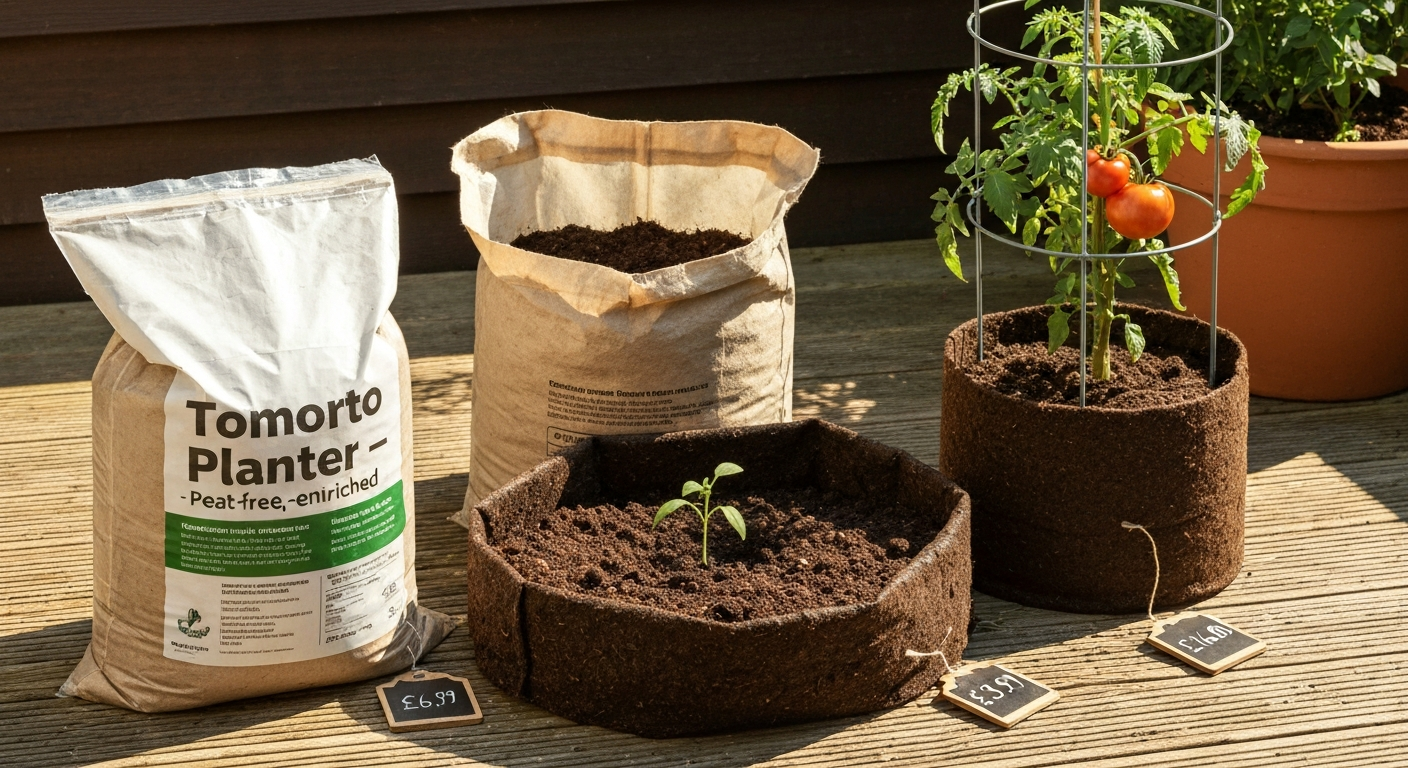
Tomorite grow bags from Levington sit in a surprisingly wide price band depending on where you buy: the 46 L Deep Planter runs around £13.99–£16.80 at B&Q, while the 52 L Giant Planter can drop as low as £6.99 at independent garden centres like Blackbrooks. That near-£10 gap for a larger bag at a cheaper retailer is the core opportunity here. Shop around across garden-centre chains, online marketplaces and local independents, time your purchase for early-season promotions, and use a quick price-per-litre calculation to cut through the noise and spot a genuine deal.
Tomorite Grow Bags Best Price: Buyers Guide & Value Tips Now
Marcus Holloway
27 Jul 2026
Who this guide is for and what you'll get out of it
Whether you're planting out your first tomatoes on a patio or you've been running grow bags for a few seasons and want to tighten up your spending, this guide covers the same ground. I'll walk through realistic UK retail price ranges for Levington Tomorite pre-filled planter bags, show you where to find the best price across different buying channels, explain how fabric construction and bag size affect value (because yes, there are fabric grow bags and pre-filled compost planters, and they're quite different things), and give you a short framework for evaluating any tomato grow bag from budget to premium. I'll also touch on compatible accessories, including matching bags to the right tomato support.
What to expect on price: retail, sale and bulk
Tomorite grow bags are pre-filled peat-free compost planters sold by Levington (Evergreen Garden Care), and their pricing behaves more like bagged compost than like fabric pots. The headline price depends heavily on the retailer and the specific SKU. Here's what the real-world market looks like right now.
| SKU / Size | Retailer Example | Indicative Price | Price per Litre |
|---|---|---|---|
| 46 L Deep Planter (peat-free, 3-plant) | B&Q (online/store) | £13.99–£16.80 | ~£0.30/L |
| 52 L Giant Planter | Blackbrooks Garden Centre | £6.99 | ~£0.13/L |
| 52 L Giant Planter (trade/ex-VAT) | Trade wholesaler (e.g., Burnley Plumb Supplies) | £13.50 ex-VAT | ~£0.26/L |
| Various sizes via eBay (resellers) | eBay UK marketplace | Variable by seller | Calculate per listing |
The price-per-litre formula is the single most useful number you can calculate before buying. Divide the retail price by the bag's volume in litres. At B&Q's listed price, the 46 L bag works out to about £0.30 per litre. The Blackbrooks 52 L bag at £6.99 comes out at roughly £0.13 per litre. That's more than a 50% difference in cost per unit of growing medium. When comparing bags of different sizes or from different sellers, always run this calculation rather than comparing headline prices.
What counts as a good deal? I'd treat anything below £0.20 per litre for a branded, peat-free, pre-enriched Tomorite planter as strong value. Between £0.20 and £0.30 is mid-range and still reasonable if the retailer is convenient. Above £0.30 per litre, you're paying a premium either for convenience or for a larger retailer's margin, and it's worth checking alternatives before checking out.
Bulk pricing is less structured for pre-filled Tomorite bags than it is for fabric grow bags. Pre-filled bags are heavy and expensive to ship, so they move through garden-centre chains and regional trade wholesalers rather than through Amazon fulfilment or wholesale platforms like Alibaba. If you're growing at scale (say, 10+ bags for a greenhouse run), calling a local trade wholesaler or garden-centre group and asking about case pricing is worth the five-minute effort. Fabric grow bags, by contrast, are available in bulk from Asian manufacturers on Alibaba with genuinely low per-unit costs, but with minimum order quantities and shipping lead times that only make sense if you're buying dozens at a time.
Where to buy and how to save
Retail channels worth checking
- B&Q: Consistent national availability, listed online with click-and-collect; prices tend to sit at the higher end of the range. Good for convenience but check the price per litre before defaulting here.
- Independent garden centres: Often the biggest price variation. Blackbrooks' £6.99 example shows how far off the B&Q price an indie can be. Worth a phone call or quick website check before the growing season kicks off.
- eBay UK: Small garden-centre sellers and resellers list Tomorite bags here. Useful for finding stock when local centres have sold out mid-season, but watch for shipping costs that can erode any price advantage.
- Trade wholesalers: If you can meet a minimum order or have a trade account, ex-VAT pricing (e.g., £13.50 for 52 L) can beat retail even after you factor VAT back in for non-VAT-registered buyers, depending on the retailer's retail markup.
- Supermarkets and DIY chains: Homebase and similar occasionally stock Tomorite bags seasonally. Prices can be competitive but range is limited and stock disappears fast.
Timing and sale strategies
The UK grow-bag market is heavily seasonal, which creates predictable sale windows. Stock arrives at garden centres from late February through March; end-of-April and early-May promotions are common as retailers push sell-through before peak planting. If you can wait, late-season clearance (from late July into August) often sees deep discounts, but by then a lot of the growing season is gone. My practical advice: buy what you need for the current season in March or April when selection is best, and stock up on any clearance lines in August only if you have somewhere dry to store them (pre-filled bags don't like freezing or prolonged damp storage).
For price tracking on any Tomorite SKUs that appear on Amazon, tools like Keepa and CamelCamelCamel let you set price-drop alerts at the ASIN level without needing to check manually. Pre-filled Tomorite bags aren't consistently Amazon-fulfilled, but marketplace sellers do list them, so setting a tracker takes 30 seconds and can pay off. Retailer loyalty schemes (B&Q's DIY Rewards, for instance) occasionally stack discount vouchers with existing promotions, which is worth bearing in mind if you're already a member.
How fabric and construction affect value
This section matters most if you're considering fabric grow bags (reusable, air-pruning pots) rather than or alongside pre-filled Tomorite planters. The two products serve similar purposes but have very different value profiles over time.
Fabric weight is the primary durability indicator for reusable fabric grow bags. Non-woven needle-punched polypropylene (the most common material) runs from around 90 g/m² at the lightweight end to 250–300 g/m² for heavy-duty versions. Manufacturer datasheets show common grades, for example, Danosa's Danofelt PP 200 is specified at 200 g/m² Manufacturer datasheets show common grades—for example, Danosa's Danofelt PP 200 is specified at 200 g/m².. Root Pouch's own spec sheet maps this out clearly: their Thin Black fabric at ~90 g/m² is positioned as a short-season option, the Charcoal line at ~150 g/m² is rated for roughly 18–24 months of use, and heavier lines run to 3–5 seasons or more with proper care. At 90 g/m² you're essentially buying a single-season propagation bag. At 200 g/m² or above, you're buying something that can do three to five years if you wash it out and store it off the ground over winter.
Beyond fabric weight, look at seam quality, handle reinforcement and UV stabilisation. Double-stitched seams matter on anything above 10 gallons because the weight of saturated compost puts real stress on the bag walls. Reinforced handles (with a patch backing, not just stitching through single-layer fabric) are worth paying for on bags you plan to move when planted. UV stabilisation extends outdoor lifespan noticeably; bags left in direct summer sun without UV treatment can degrade and become brittle within one to two seasons.
Good drainage is non-negotiable regardless of price point. The main advantage of fabric over plastic is air-pruning of roots and passive drainage through the fabric walls. A bag that clogs, whether from a thin fabric that compresses under compost weight or poor construction that reduces wall permeability, defeats the purpose. When evaluating any fabric bag, look for reviews that specifically mention drainage performance under heavy watering, especially in greenhouse conditions where you might be watering twice a day.
Size and capacity: what the numbers actually mean for your crops
Container size is the most commonly misunderstood variable in grow-bag buying. Bigger isn't always better (you end up with waterlogged compost in oversized containers for small plants), but going too small is the more common and more costly mistake, especially with tomatoes.
Virginia Tech extension guidance gives a reliable, conservative baseline: 5 US gallons (approximately 19 L) per tomato plant is the recommended minimum for container growing. That's the floor, not the target. Indeterminate (vining) tomato varieties push roots aggressively and do noticeably better with 10–15 gallons (38–57 L) per plant. This is exactly why the Tomorite 46 L Deep Planter is positioned as a 3-plant bag: at roughly 15 L per plant it's workable for bush/determinate varieties, but if you're growing large indeterminate types like Gardener's Delight or a beefsteak variety, I'd lean toward one or two plants per bag, not three.
| Crop Type | Minimum Size per Plant | Recommended Size | Notes |
|---|---|---|---|
| Determinate/bush tomato | 19 L (5 gal) | 25–35 L | 3 plants per 46 L bag is workable |
| Indeterminate/vining tomato | 19 L (5 gal) | 38–57 L (10–15 gal) | 2 plants max per 46 L; 1 plant ideal in 52 L |
| Cucumber / courgette | 20–25 L | 35–46 L | Deep root zone helps; 1 plant per bag |
| Peppers / chillies | 10–15 L | 19–25 L | Smaller plants, less root demand |
| Herbs (basil, parsley) | 5–10 L | 10 L | Multi-plant in one bag fine |
| Flowers (bedding / trailing) | 10–20 L | 25 L | Tomorite bags work well here too |
The Tomorite 46 L Deep Planter's design specifically targets a deeper root zone compared to traditional shallow grow bags, which is a genuine improvement for tomato root development. Traditional flat grow bags (roughly 40 cm x 80 cm, often only 15–20 cm deep) restrict downward root growth. The 46 L Deep Planter format gives roots more vertical space, which translates to better access to moisture and nutrients later in the season when surface compost can dry and compact.
Single-plant versus multi-plant bags is partly a space and partly an irrigation question. Multi-plant bags are efficient on space but you're managing one moisture environment for competing root systems. If one plant struggles or develops disease, the whole bag is affected. In a greenhouse with a drip-irrigation setup or a Hozelock grow-bag waterer, multi-plant bags are more manageable because you can deliver consistent moisture to the whole bag surface. In a drier outdoor situation without automated watering, I find single-plant or two-plant bags easier to manage well.
Material and size trade-offs: when it's worth paying more
Pre-filled Tomorite planters and reusable fabric bags serve different growers, and the value calculation is genuinely different for each.
| Feature | Pre-filled Tomorite Planter | Reusable Fabric Grow Bag (good quality) |
|---|---|---|
| Upfront cost | £6.99–£16.80 per bag | £2–£8 per bag (multi-pack), varies by GSM |
| Seasons of use | Single season (compost depletes) | 3–5+ seasons (150–250 g/m²) |
| Setup effort | Open and plant — minimal | Fill with compost, position, plant |
| Portability | Heavy when filled; awkward | Light when empty; manageable filled |
| Drainage | Good (peat-free, structured) | Excellent (through fabric walls) |
| Heat retention | Better (thicker mass) | Lower (fabric breathes; can dry faster) |
| Pre-loaded nutrients | Yes — feeds up to 8 weeks | No — must add your own feed |
| Long-term cost per season | High (buy new each year) | Low (amortised over multiple seasons) |
Heat retention is worth expanding on. Fabric bags lose moisture and heat faster than solid-walled containers or pre-filled planters. In a warm greenhouse this is fine, even beneficial, because overheating is the bigger risk. On an exposed patio or balcony in a cooler UK spring, fabric bags can struggle to maintain root zone temperature. Pre-filled Tomorite planters, with their denser compost mass, hold warmth better early in the season. If you're planting out in April in a northern UK garden, that thermal mass difference is real and matters for establishment.
When should you pay more? For pre-filled bags, paying extra is justified when you want the convenience of ready-enriched, peat-free compost without the time spent sourcing and mixing your own. The Tomorite formula includes seaweed and Tomorite plant food, and the bag claims to feed for up to 8 weeks after planting, that's meaningful for a first-time grower who might otherwise forget feeding entirely. For fabric bags, paying more (for higher GSM, reinforced handles and UV treatment) is justified if you're running the same bags for three or more seasons. Saving £3 upfront on a 90 g/m² bag that falls apart after one season is a false economy.
How to score and choose: a short evaluation framework
When I look at any tomato grow bag, whether it's a Tomorite pre-filled planter or a fabric pot, I run through five quick criteria. See our tomato grow bag review for direct comparisons and model-specific recommendations. This works for budget, mid-range and premium options alike.
- Volume adequacy: Does the bag give at least 19 L per plant? For indeterminate tomatoes, am I getting 35–50 L per plant? If not, the bag is too small regardless of price.
- Price per litre: Calculate it. Under £0.20/L for pre-filled Tomorite is strong; over £0.30/L needs justification. For empty fabric bags, compare per-bag price against expected seasons of use.
- Fabric/construction quality (for fabric bags): Is the GSM stated? Is it at least 150 g/m² for a multi-season bag? Are handles reinforced? Any UV stabilisation claim?
- Drainage and aeration evidence: Reviewer comments on drainage and root health under heavy watering are more useful here than manufacturer claims.
- Feed and amendment plan: Pre-filled Tomorite bags earn marks for their 8-week built-in feeding. Fabric bags start at zero — you need a feeding plan from week one. After the initial 8 weeks in a Tomorite bag, you'll need to supplement with Tomorite liquid feed anyway (20 ml per 4.5 L water, applied at around 4.5 L per bag).
Budget, mid-range and premium: what to look for
At the budget end (pre-filled bags below £8–10, or fabric bags in multi-packs under £15 for 5 x 3-7 gallon), expect lighter compost blends, thinner fabrics (90–120 g/m²) and no guarantee of multi-season durability. Representative marketplace listings and price-aggregation pages (for example, Mactoou Grow Bags for Vegetables, 5 Pack 3 Gallon Non‑Woven, marketplace listings / price aggregator (example)) show 5‑pack fabric bag offers in the roughly £13–£30 range depending on size and fabric weight Mactoou Grow Bags for Vegetables, 5 Pack 3 Gallon Non‑Woven — marketplace listings / price aggregator (example). These work fine for a single season of determinate tomatoes, herbs or annual flowers, and they're a sensible low-risk entry point if you're new to grow-bag growing.
Mid-range options (Tomorite 46–52 L bags from well-priced retailers at £7–£12, or fabric bags at 150–200 g/m² from reputable brands at £3–£5 per bag in packs) represent the best value for most home growers. You're getting adequate volume, decent construction and a reasonable cost-per-season ratio. This is where I'd point the majority of growers, beginners and experienced alike.
Premium options (fabric bags at 200–300 g/m² from specialist manufacturers, or larger-volume Tomorite planters at full retail price for the specific convenience they offer) make sense for growers running 10+ bags over multiple seasons or those with specific large-plant requirements. The per-unit price is higher but the total cost over three to five seasons often works out lower than buying budget bags every year.
Tomato-specific setup: bags, cages, stakes and support
Tomatoes in grow bags have a support problem that container growers underestimate. A pre-filled 46–52 L planter on a hard surface can't have canes driven into the ground beneath it, and the compost depth alone won't hold a tall indeterminate plant under fruit load. You need a support system that either works within the bag itself or connects to an external structure.
For determinate (bush) types in a 46 L Tomorite bag, a standard 90–120 cm bamboo cane pushed firmly to the bag's base is usually sufficient, the bag's compost depth provides enough anchor. For indeterminate varieties, you're better off with a tomato cage that sits around the bag, or a free-standing spiral stake or a tall cane tied to a greenhouse rail or wall-mounted support. When matching cages to grow bags, look for cages with a base footprint that fits the bag's top diameter without tipping. The best tomato cages for grow bags typically have a wide, stable base rather than the typical 3-legged garden designs that sink into the bag unevenly and topple under wind.
Staking best practices for bags: push canes or stakes to the bottom of the bag (not just halfway) to maximise anchorage in the compost. Space multiple canes evenly around the perimeter for multi-stem plants. If you're using a free-standing cage, fill it to the bag's perimeter before the plant grows tall, repositioning a cage around a heavily fruiting plant mid-season is a reliable way to damage stems. For heavy-fruiting varieties, I also loop soft garden twine around the bag itself at mid-height and tie it to a fixed point, which transfers some of the tipping load away from the compost anchor and onto the structure.
On watering: consistent moisture in tomato grow bags is critical and harder to achieve than in open beds. The Tomorite bag's peat-free compost can dry at the surface while staying wetter lower down, which encourages shallow rooting and increases the risk of blossom end rot from inconsistent calcium uptake. A grow-bag-specific drip or wick-based waterer (designed to sit on or in the bag surface) makes a real difference here, especially for greenhouse growers running multiple bags. The cost of a decent waterer is modest and protects a much larger investment in plants and compost.
Using Tomorite bags for other crops
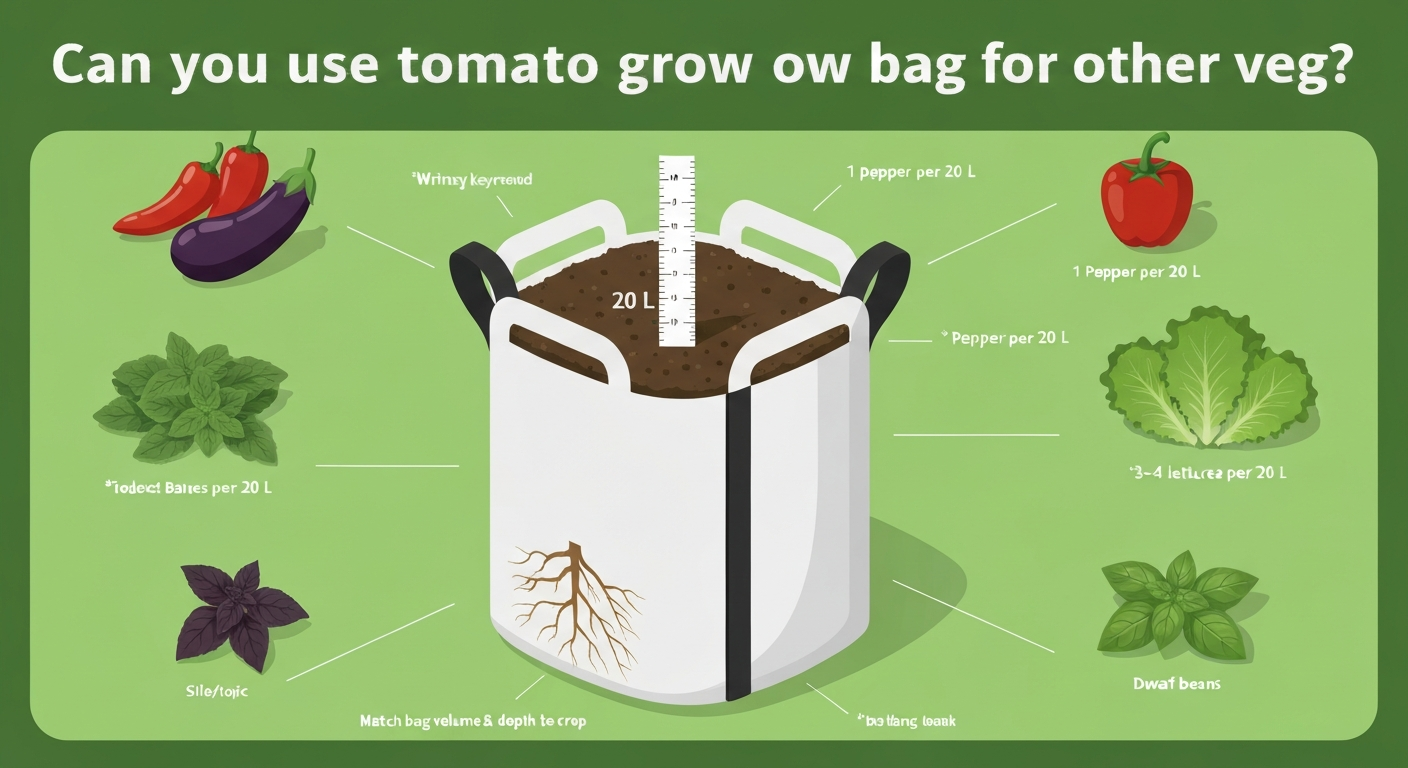
Tomorite bags aren't just for tomatoes, and the Tomorite feed and seaweed enrichment in the compost supports any heavy-feeding fruiting or flowering plant. For more on using tomato grow bags for other vegetables, see can you use tomato grow bags for other veg. Cucumbers and courgettes do very well in the 46–52 L bags (one plant per bag for cucumbers; the volume is generous enough). Peppers and chillies thrive in the compost blend. Annual flowers, particularly trailing and bedding plants, perform well in the peat-free mix with minimal additional feeding. If you're wondering whether you can use tomato grow bags for flowers, the short answer is yes, annual bedding and trailing plants do well in Tomorite's enriched mix can you use tomato grow bags for flowers. Even strawberries, which Levington explicitly markets companion products for, can go into Tomorite bags for a productive season.
Where Tomorite pre-filled planters are less suitable: mushrooms (wrong substrate entirely, mushrooms need species-specific growing media, not enriched general compost), trees and large perennial shrubs (the single-season format isn't designed for multi-year occupancy), and crops that need very fast drainage like Mediterranean herbs (the enriched compost can stay too moist). For those applications, a reusable fabric bag filled with appropriate media is the better tool.
After the main crop finishes, the depleted compost from a Tomorite bag still has value as a soil conditioner dug into beds or borders. It shouldn't be used as a standalone growing medium for another crop in the same season, the feed is spent and the compost structure will have broken down, but it's not waste.
A buying checklist before you order
Before you commit, run through these questions quickly. They cut out most bad purchases.
- What crop and how many plants? Match volume to the per-plant minimum (19 L for tomatoes, more for indeterminate types).
- Pre-filled or reusable fabric bag? Pre-filled Tomorite bags win on convenience and first-season setup. Fabric bags win on multi-season cost. Be honest about which matters more to you.
- What's the price per litre? Calculate it for every option you're comparing. Target under £0.20/L for pre-filled Tomorite.
- Where are you growing? Greenhouse or sheltered patio favours fabric bags. Exposed outdoor spots or early-season planting favours the thermal mass of pre-filled bags.
- Do you have a feeding plan after week 8? Tomorite bags feed for up to 8 weeks. After that, switch to weekly Tomorite liquid feed (20 ml per 4.5 L water, approximately 4.5 L per bag per application).
- What support system are you using? Confirm your cage or stake setup suits the bag size and tomato variety before you plant.
- Have you checked multiple retailers? A quick check of your nearest independent garden centre alongside B&Q's online listing takes two minutes and can save several pounds per bag.
FAQ
What price should I expect to pay for pre-filled Tomorite grow bags in the UK?
Expect wide retailer variation. Typical retail listings for Levington Tomorite pre-filled planters (46–52 L) fall roughly between £6–£17 per bag. Use price-per-litre to compare: e.g., £13.99 ÷ 46 L ≈ £0.30/L; £6.99 ÷ 52 L ≈ £0.13/L. Watch garden-centre promos and independent sellers for the lowest per-unit prices.
Are there cheaper alternatives to pre-filled Tomorite grow bags?
Yes. Two common routes: (1) Buy plain fabric grow bags and fill with your own compost — fabric bags (small sizes) often sold in multi-packs for ~£10–£30 per 5-pack depending on size and GSM; (2) Buy bulk compost + fabric or plastic containers. Heavy-duty fabric bags cost more up-front but are reusable for multiple seasons, lowering cost-per-season.
Where’s best to search for deals, coupons and bulk pricing?
Check multiple channels: garden-centre websites and local stores (often run promotions), independent online retailers and eBay, and trade/wholesale listings for bulk orders. Use price-tracking tools (Keepa or CamelCamelCamel for marketplace SKUs) and monitor seasonal sales (spring/summer). For fabric bags, Alibaba or trade suppliers give low unit FOB prices but require MOQs and shipping lead times.
How do I compare value across bag sizes and types?
Normalize price by litre: price-per-litre = unit price ÷ bag litres. Compare pre-filled bags (cost includes compost & feed) against fabric bag + cost of compost. Also factor in reusability: pre-filled planters are a single-season convenience; heavy fabric bags (higher GSM) can last 2–5+ seasons depending on weight and exposure, improving long-term value.
How does material and fabric weight (GSM) affect value and lifespan?
Thinner nonwoven fabrics (~90 g/m²) are cheaper but typically last 1–2 seasons; midweight (~150 g/m²) often lasts 2–3 seasons; heavier lines (~200–300 g/m²) give multiple seasons (3–5+) and resist tearing. Heavier fabric costs more up-front but is worth it if you plan to reuse bags yearly.
What size grow bag do tomatoes need?
Follow extension guidance: a conservative minimum is ~5 gallons (~19 L) per tomato plant. For indeterminate/vining varieties or multiple plants in one container, aim for 40–50+ L per plant or use a 46–52 L Tomorite planter for 1–3 plants depending on variety and root space desired.
Next Articles
Can You Use Tomato Grow Bags for Other Veg? Practical Guide
Yes - tomato grow bags work for many veg: which crops, bag sizes, planting tips, watering and when to buy specific bags
Tomato Grow Bag Review: Best Options, Setup, Care Tips
Tomato grow bag review with top picks, setup steps, care schedule, and fixes for dry, nutrient, and yield issues.
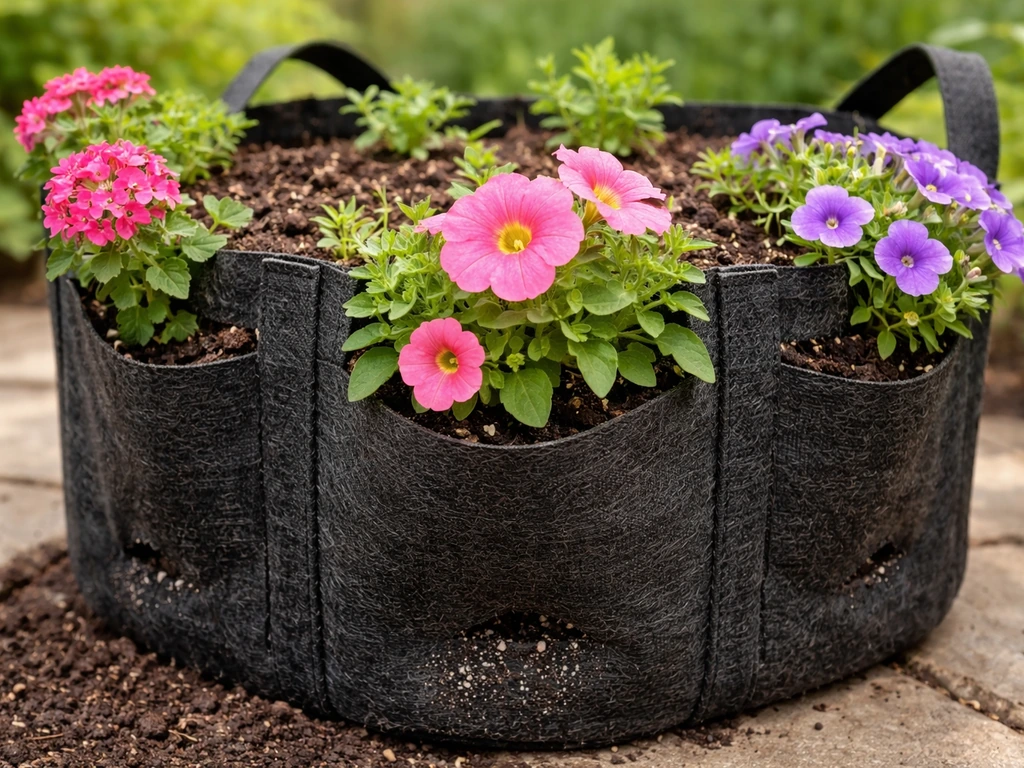
Can You Use Tomato Grow Bags for Flowers? Tips
Yes, use tomato grow bags for flowers. Get soil, drainage, watering, feeding, and sizing tips for healthy blooms.