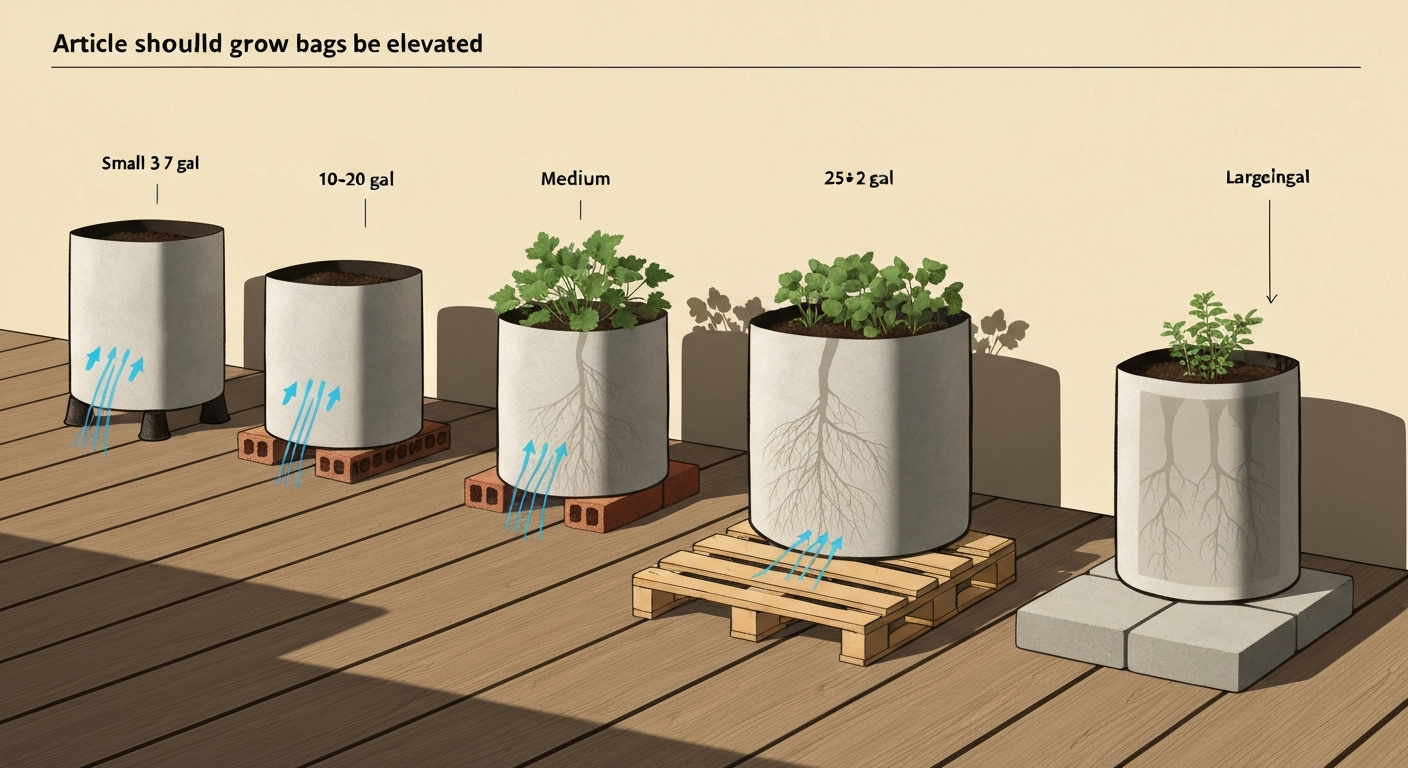
Yes, you should elevate most fabric grow bags, at least slightly. Raising them 1 to 2 inches (2.5 to 5 cm) off the ground on bricks, pot feet, a wooden pallet, or a wire shelf allows drainage to flow freely, lets air circulate under the bag, and keeps the fabric base from sitting in pooled water that promotes root rot and fabric degradation. That said, elevation is not a strict rule for every situation. A large 25-gallon tree bag on a sturdy ground-level patio is perfectly fine as long as drainage isn't blocked. The real question is whether your specific setup lets water drain, air move, and roots stay healthy. This article walks through exactly when elevation helps, when it doesn't matter much, and how to do it safely for every major plant type. For a focused answer, read do grow bags need to be off the ground.
Should Grow Bags Be Elevated? Terrace & Garden Guide
Why elevation matters: drainage, airflow, temperature, and watering
The whole advantage of a fabric grow bag is its porous sidewall. Non-woven polypropylene fabric (typically 80 to 300 g/m² for quality grow bags) breathes in a way that smooth plastic containers simply cannot. That porosity drives two core benefits: it lets excess water escape freely and it triggers air-pruning, where root tips that reach the sidewall or base dry out and stop elongating instead of circling the container. Research published in HortScience (Million and Yeager, 2022) confirmed that fabric containers reduce root circling compared with conventional plastic pots, producing denser, more fibrous root systems that establish better after transplant. See the HortScience article (Million & Yeager, 2022), fabric containers’ air‑pruning and reduced root circling for experimental evidence that porous fabric sidewalls cause air‑pruning and greatly reduce root circling compared with smooth plastic pots HortScience article (Million & Yeager, 2022) — fabric containers’ air‑pruning and reduced root circling. But both of those benefits are compromised the moment the bag base sits in a puddle or is pressed flat against an impermeable surface with no gap beneath it.
Airflow underneath the bag matters more than most growers realize. When a fabric bag sits directly on a solid deck or concrete surface, the bottom layer of substrate stays wet longer after watering, oxygen levels in that zone drop, and beneficial soil microbes can be displaced by anaerobic conditions. Raising the bag even an inch breaks that seal. Cooler air moving underneath also helps regulate root-zone temperature, which is genuinely important on exposed terraces in summer when dark-colored surfaces can radiate heat up through the bag base. The same HortScience study noted that fabric containers reduced substrate wall temperatures compared with conventional black plastic pots, an advantage that's partially negated if the bag sits on a scorching dark patio with no airspace below.
There's a watering trade-off to acknowledge here honestly. Elevated bags with good airflow dry out faster than bags sitting flat on the ground. The same porous sidewall that drains well also loses moisture through sidewall evaporation, and elevation adds bottom evaporation on top of that. The HortScience research flagged increased irrigation demand as a real consequence of using fabric containers. So if you elevate, expect to water more frequently, especially during hot, windy weather. For most home growers that's a worthwhile trade, since overwatering and root rot kill far more container plants than underwatering does, but it's worth knowing before you commit to a raised setup.
Pros and cons of elevating grow bags
| Factor | Elevated | Ground-level |
|---|---|---|
| Drainage | Freely unobstructed; excess water drains immediately | Can pool if surface is impermeable; base fabric stays wetter |
| Air-pruning effectiveness | Full base and sidewall air-pruning active | Base air-pruning reduced where bag contacts surface |
| Root-zone temperature | Better airflow helps moderate soil heat on hot surfaces | Absorbs heat from dark paved surfaces in summer |
| Watering frequency | Higher — faster drying from all surfaces | Lower — reduced bottom evaporation |
| Pest access (slugs, ground insects) | Reduced; harder for soil pests to climb elevated structure | Easier access for slugs, earwigs, and fungus gnats |
| Stability/wind risk | Higher tipping risk, especially for tall or light bags | More stable on flat ground |
| Deck/surface protection | Prevents water staining, rot, and mineral deposits on decking | Prolonged pooling can stain and damage timber or composite decking |
| Ease of moving | Slightly easier to slide under or lift with a hand truck | Needs to be lifted fully; can suction-stick to wet surfaces |
| Cost | Requires pot feet, pallets, bricks, or stands (low to moderate cost) | No additional cost |
The bottom line from that comparison is that elevation wins on plant health and surface protection for most setups, but you're trading off a higher watering load and some stability. For terrace and balcony growers especially, protecting the deck surface from trapped moisture and staining is a strong practical reason to elevate beyond just the plant-health argument.
Vegetables: when to elevate and when to leave them on the ground
For most vegetable crops in fabric grow bags, I recommend elevating on pot feet, bricks, or a slatted pallet. Tomatoes, peppers, cucumbers, and eggplants are deep-rooting, heavy feeders that need both excellent drainage and strong aeration. A 10- or 15-gallon bag of saturated potting mix is already pushing the watering schedule hard during peak summer; you do not want the base sitting in a puddle between waterings and adding anaerobic stress to roots that are already working overtime. Raising the bag 1 to 2 inches is enough. A standard half-brick (about 3 inches / 7.5 cm) under each side works perfectly.
Potatoes and root vegetables are a slightly different story. These crops actually benefit from the bag sitting more snugly because you want moisture retention consistent enough to prevent hollow heart or splitting. On a well-draining gravel or bark mulch surface rather than solid concrete, I'm comfortable leaving potato bags at ground level, especially if rain is frequent. On impermeable surfaces like decking or tiled patios, still elevate them but use minimal height so evaporation isn't excessive.
Leafy greens and herbs in smaller bags (3 to 7 gallons) are the most forgiving. They're light enough to move, shallow-rooted enough to tolerate slightly less-than-perfect drainage, and they cycle fast enough that any surface compaction or moisture issue rarely has time to become a serious problem before you're harvesting and replanting. That said, I still elevate them on a simple tray with drainage holes, mostly because it protects wooden or composite decking from constant moisture and makes watering cleaner.
Recommended elevation heights and supports for vegetables
- Tomatoes, peppers, cucumbers (10–20 gallon bags): 2–3 inch elevation on bricks, pot feet, or a wooden/plastic riser
- Potatoes (10–20 gallon bags): 1–2 inch elevation on pot feet; prioritize consistent moisture over airflow
- Leafy greens and herbs (3–7 gallon bags): 1–2 inch elevation on a tray with drainage holes or simple pot feet
- Squash and pumpkins (20–30 gallon bags): elevation optional on ground-level gardens; helpful on decking to protect surface
Flowers and ornamentals: benefits and cautions
Flowering annuals like petunias, marigolds, and zinnias in 3- to 7-gallon fabric bags thrive when elevated because their fine root systems are particularly sensitive to waterlogging and because most of these plants want warm, well-aerated conditions. Raised on a simple pot stand or a few bricks, they drain quickly after rain, get airflow all around, and reward you with dense, healthy root growth that supports heavier flowering. Elevation also makes deadheading and general maintenance easier on your back, especially on a terrace where bags might sit 30 or 40 cm below comfortable working height.
Perennial ornamentals and bulb crops (dahlias, cannas, lilies) are worth elevating with more care. These plants build large rhizomes or tubers and need substrate that stays consistently moist without waterlogging. Elevation is still beneficial here, but you may want to use a saucer underneath the elevated bag to catch and hold a small reservoir of water during dry spells, then empty it if rain arrives. This is especially relevant on exposed terraces where wind accelerates drying considerably.
One caution for ornamentals: tall or top-heavy flowering plants in smaller bags can become unstable when elevated on narrow pot feet. A dahlia in full growth in a 10-gallon bag on a set of three small rubber pot feet is a tipping hazard in any significant wind. Either use a wider stable platform like a pallet section or a proper plant stand with a broad base, or group several bags together so they brace each other. Wind anchoring is discussed in more detail in the terrace section below.
Small trees, shrubs, and large containers
This is where elevation advice changes. A 25-, 45-, or 65-gallon fabric bag holding a young fruit tree, ornamental shrub, or dwarf olive is heavy. At saturation, a well-mixed potting substrate (coir/peat base with perlite at roughly 10 to 15 percent by volume) typically comes in around 0. Irrigation and Drainage Engineering, soil bulk density and porosity (textbook reference showing typical bulk density ranges) notes mineral soils commonly have dry bulk densities near 1.3 g/cm³ (about 1.0–1.8 g/cm³ depending on texture/compaction), while organic‑rich potting mixes frequently measure below 1.0 g/cm³, and these standard ranges are used when estimating saturated weights for container load calculations Irrigation and Drainage Engineering — soil bulk density and porosity (textbook reference showing typical bulk density ranges). 6 to 0.9 kg per liter depending on mix and moisture level. A 25-gallon bag (roughly 95 liters) at saturation can weigh 60 to 90 kg (130 to 200 lb) before you count the fabric and the plant itself. Elevated structures for bags this size need to be chosen carefully.
Nursery and research evidence supports fabric containers for tree production, with multiple studies finding that trees grown in air-pruning fabric containers develop fewer circling and girdling roots compared to smooth plastic pots, leading to better post-planting establishment. Root Pouch and similar manufacturers produce heavy-duty fabric containers specifically rated for tree production, with UV-resistant non-woven fabrics designed for multi-season use outdoors. The air-pruning benefit is real and worth preserving, which means keeping the bag base off an impermeable surface where possible.
For large tree and shrub bags, I prefer a low-profile solution: a single layer of standard half-bricks or flat concrete paving slabs set so the bag rests on several contact points with gaps between them for drainage and airflow. This gives roughly 3 to 5 cm of clearance with very good stability and no meaningful wind-tipping risk. Dedicated plant dollies with castors are another option if you need to move the bag seasonally, but make sure the dolly is rated well above the saturated bag weight. For a 25-gallon bag that could easily hit 90 kg saturated, you want a dolly rated for at least 120 kg with a broad platform to prevent tipping.
Mushrooms and other specialty crops
For mushroom cultivation, elevation from the floor is standard practice rather than optional. Colonized grain or substrate bags that move into a fruiting space are almost universally placed on wire shelving or hung from racks. The reason is straightforward: mushrooms need crossflow air exchange to trigger pinning and sustain healthy fruiting bodies, and a bag sitting directly on a floor in a fruiting tent or chamber gets minimal airflow on its base. Metal wire shelving (commercial NSF-rated shelving is commonly used) spaces bags so air can circulate around every surface. The NCAT/ATTRA mushroom cultivation guide recommends shelves or racks specifically to maintain air exchange and allow free drainage during the fruiting stage.
Practically, this means elevating mushroom grow bags by at least 15 to 30 cm (6 to 12 inches) on wire shelving, which is a much greater clearance than you'd use for vegetable or ornamental bags. The goal isn't just drainage; it's ensuring that the CO2-rich air that accumulates near the floor of a fruiting chamber doesn't stagnate around the bags. Research protocols for controlled mushroom cultivation consistently note that colonized bags are transferred to fruiting-space shelves as a standard step, not an optional one.
Other specialty crops, including microgreens in shallow bags and aquatic or semi-aquatic plants, have different requirements. Microgreen bags do well slightly elevated on a tray system for drainage management. Semi-aquatic plants obviously should not be elevated in a way that dries them out faster. For these niche cases, the rule is: understand what your specific crop needs from its root zone and let that drive the elevation decision, not a one-size-fits-all default.
Terrace-specific considerations
Load limits and weight calculations
This is the section terrace and balcony growers need to take seriously. Residential balcony and deck design in the US is typically governed by codes that reference ASCE 7, with a commonly applied minimum design live load for exterior balconies of 60 pounds per square foot (approximately 2.87 kPa). That sounds like a lot, but a concentrated collection of heavy grow bags can approach or exceed that figure in a small area very quickly. Here is a simple screening calculation: estimate your saturated substrate weight per bag, add the bag and plant weight, and compare to your available floor area.
A worked example: three 20-gallon bags (each approximately 76 liters of saturated mix at roughly 0.8 kg/liter = about 61 kg each, plus plant and fabric, call it 65 kg each). Three bags total roughly 195 kg (about 430 lb). If they sit within a 1 square meter area, that's already 195 kg/m² or about 40 psf. Add a person standing nearby, a patio chair, and a second row of smaller bags, and you can approach the 60 psf limit in a surprisingly small terrace corner. If you're stacking bags on shelving that concentrates load at four feet rather than spreading it across the full floor area, the point load at each shelf foot can be significantly higher. The rule: if you have any doubt about your terrace's structural capacity, consult a structural engineer. Reorganizing bag placement to spread load more evenly is usually the simplest solution.
Sun exposure and surface heat
On a south- or west-facing terrace in summer, dark paved surfaces can reach surface temperatures well above 50°C (122°F) under direct sun. Elevation prevents direct heat transfer through the bag base, and a 2 to 5 cm air gap acts as meaningful insulation. If you're on a highly exposed terrace, consider reflective paving tiles, a light-colored gravel mulch layer, or placing bags on light-colored pallets or wooden slatted stands to further reduce base heat. The fabric sidewall temperature advantage documented in HortScience research is most relevant in exactly these high-heat terrace scenarios.
Wind, anchoring, and safety
Elevated bags are more vulnerable to wind than bags sitting flat. On a terrace above the second or third floor, wind loads can be substantial and unpredictable. Small elevated bags (under 10 gallons) in exposed positions can tip in winds that wouldn't trouble a ground-level garden. Practical solutions include grouping bags together on wide, low platforms so they brace each other, threading a light rope or bungee around grouped bags to a fixed anchor point, or placing the heaviest bags at the outer edge to act as a windbreak for smaller ones. Never place elevated bags on a balcony parapet wall or railing shelf unless the shelf is purpose-built and anchored. A falling bag is a serious hazard to anyone below.
Neighbor, building, and planning rules
In apartment buildings and managed residential developments, terrace gardens can be subject to building management rules that restrict permanent fixtures, large planters, or structures attached to the building fabric. Shelving systems bolted to walls, large pallet platforms, and overhead hanging frames may require permission. Check your lease or body corporate rules before installing anything fixed. In many jurisdictions, planters visible from street level may also be subject to local planning conditions, particularly in heritage zones. This is less often a concern for simple bag elevation (bricks, pot feet) and more relevant to installed shelving or structural racks.
Space efficiency on a terrace
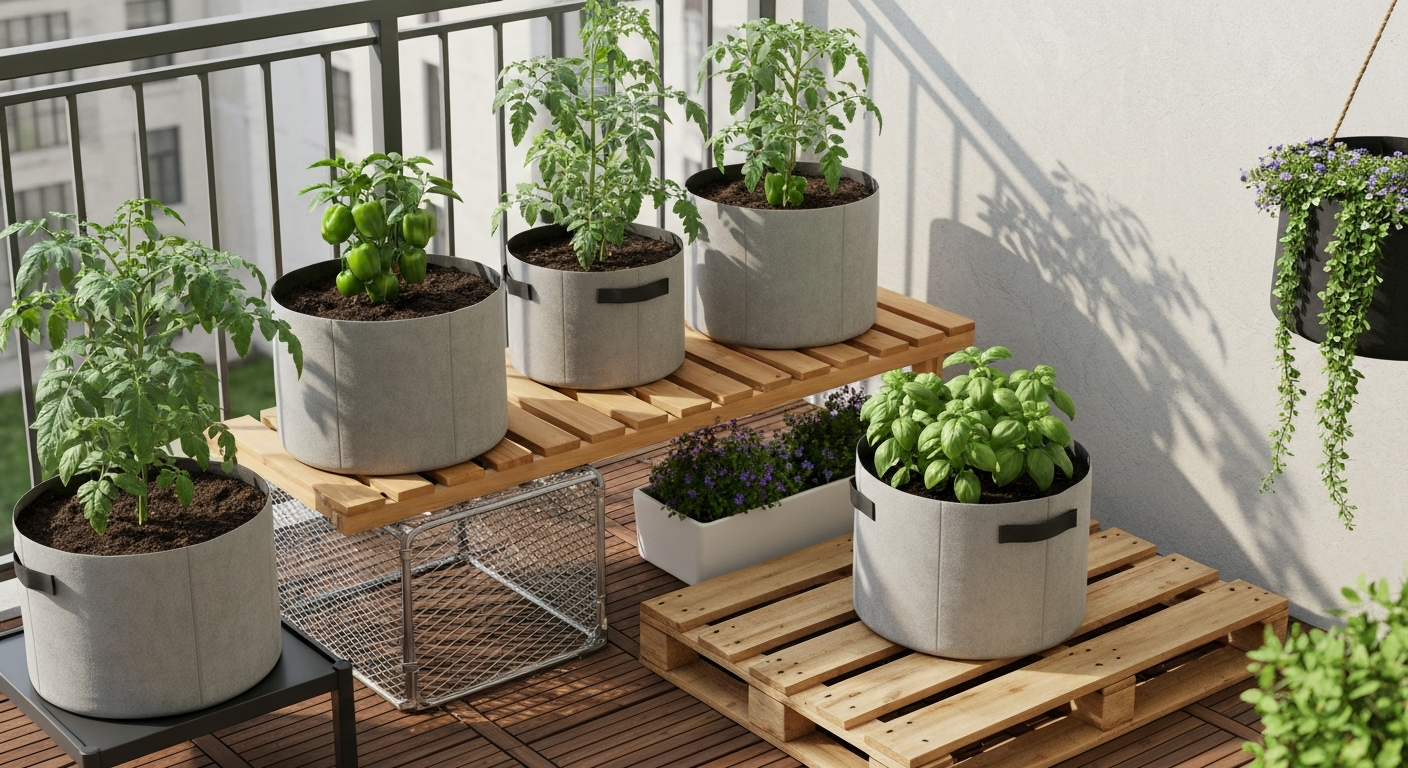
One underappreciated advantage of elevating grow bags on tiered shelving on a terrace is the vertical space efficiency it creates. A three-tier wire shelving unit in a 60 cm x 120 cm footprint can hold 9 to 12 small bags where only 3 to 4 would fit at ground level. For terrace gardeners working with limited floor area, this is a genuine yield multiplier. The caveats are the load calculations discussed above, wind stability of taller shelving units, and ensuring the upper shelves don't shade the lower ones completely. Prioritize tall, light-loving crops like tomatoes and peppers at the top, lower-light herbs and leafy greens on middle shelves, and shade-tolerant crops or mushroom blocks at the bottom.
Practical elevation methods and what to use
You don't need to spend much to elevate grow bags effectively. See our guide on how to keep grow bags off the ground for step-by-step options and recommendations. The best method depends on your bag size, how many bags you have, and what surface you're working on. Here's what I've used and what I'd recommend for different situations.
| Method | Best for | Typical height | Pros | Watch out for |
|---|---|---|---|---|
| Pot feet (rubber or ceramic) | Small to medium bags, 3–15 gallon | 2–5 cm | Cheap, non-marking, easy to move | Narrow footprint can tip larger bags |
| Half-bricks or paving slabs | Medium to large bags, 10–65 gallon | 3–8 cm | Cheap, very stable, good load spread | Heavy; can crack composite decking if not padded |
| Wooden pallets | Multiple bags, 5–30 gallon each | 10–15 cm | Spreads load, raises multiple bags at once, cheap or free | Can rot if constantly wet; check for chemical treatments (HT-marked pallets are safe) |
| Slatted wooden plant stand | Medium bags, decorative terraces | 15–40 cm | Attractive, good airflow | Check weight rating carefully; some ornamental stands are rated for much less than you expect |
| Wire/metal shelving | Mushroom bags, small vegetable bags, vertical growing | 15–90 cm per tier | Excellent airflow, stackable, adjustable | Wind stability; needs anchoring on exposed terraces |
| Plant dollies with castors | Large tree/shrub bags you need to move | 5–10 cm | Mobility; easy repositioning | Check weight rating; locking castors essential on sloped surfaces |
For most home growers with a mix of vegetable and ornamental bags, a combination of half-bricks or pot feet for individual medium bags and a slatted wooden pallet for grouped smaller bags covers the majority of situations well. If you're moving further into terrace growing with multiple bags across different plant types, the guidance on how to elevate grow bags and how to keep grow bags off the ground covers specific builds and configurations in much more detail, including DIY pallet platform plans and anchoring approaches for exposed balconies.
Troubleshooting common elevation problems
A few issues come up regularly once growers start elevating bags, and they're all straightforward to fix.
- Sagging base: Fabric bags on narrow supports can develop a hammock sag where the base fabric bows between contact points. This concentrates moisture in the center and reduces air-pruning at the base. Fix it by using a solid or closely slatted platform so the base is uniformly supported, or switch to a bag with a reinforced base fabric (heavier GSM).
- Tipping: Usually caused by a top-heavy plant, a narrow elevated platform, or wind. Move the bag to a wider platform, group bags together for mutual support, or stake tall plants to a nearby wall or rail rather than letting the plant lean and shift the bag's center of gravity.
- Poor drainage despite elevation: If your potting mix is compacted or heavy (common with garden soil in bags), elevation helps but doesn't solve the underlying mix problem. Add perlite at 10 to 20 percent by volume to the mix. Expanded perlite has a bulk density of roughly 30 to 150 kg/m³ depending on grade, meaning it adds almost nothing to the weight while dramatically improving drainage and aeration.
- Pest access: Elevation reduces but doesn't eliminate slug and snail access. If you're still seeing slug damage, use copper tape around the elevation supports. Wire shelving legs can be banded with copper tape effectively.
- Uneven watering: Elevated bags can dry unevenly, with the exposed base and south-facing side drying faster. Water thoroughly until runoff is visible from the base rather than estimating by feel on top. Consider a drip irrigation ring for larger bags during peak summer.
Choosing the right grow bag if you plan to elevate
Not all fabric grow bags handle elevation equally well. When the base of a bag is in the air with less surface contact, the fabric takes on more mechanical stress from the substrate weight. Bags with a heavier non-woven fabric, typically 150 g/m² or above for medium and large sizes, resist sagging and maintain their shape far better than lighter economy bags in the 80 to 100 g/m² range. Root Pouch and similar brands producing containers for professional nursery use specify UV-resistant, BPA-free non-woven fabric across their range, and their heavy-duty sizes are designed to hold root systems of trees and large shrubs without base deformation. If you're buying bags specifically for elevated use, prioritize a heavier GSM rating and check whether the bag has reinforced handles that can take the load if you need to lift it when full. For terrace gardens specifically, the best grow bags for terrace gardens article covers material, size, and construction recommendations in detail alongside specific brand comparisons. See our guide on best grow bags for terrace garden for detailed material, size, and brand recommendations.
FAQ
Bottom line: should grow bags be elevated?
Bottom line: Yes—elevate fabric grow bags when it improves drainage, airflow, plant health or maintenance access. Elevation of 2–10 cm (1–4 in) is sufficient for routine drainage and airflow; higher elevation (20–120 cm / 8–48 in) is useful for ergonomics, pest reduction, mushroom/fruiting setups, or terrace safety. Do not elevate if elevation risks tipping or exceeds the structural load capacity of the terrace/deck without calculation and approval.
Why elevate fabric grow bags? Evidence‑based pros and cons
Pros: - Improves drainage and prevents standing water under the bag, reducing root oxygen stress and rot (extension guidance & container gardening sources). - Increases sidewall airflow and evaporative cooling, helping moderate substrate temperatures (nursery research shows fabric containers reduce wall temps vs. black plastic; Million & Yeager 2022). - Allows full benefit of air‑pruning (better root architecture) by exposing sidewalls to airflow. - Easier pest inspection, watering runoff control and maintenance access. - Needed for mushroom/fruiting setups to allow drip drainage and airflow (mushroom protocols). Cons: - Elevation can increase irrigation frequency because fabric pots dry faster (Million & Yeager 2022). - Raised, unsecured bags may tip in wind or be unsafe on narrow ledges. - Raising heavy, saturated bags can create concentrated loads on balconies—may approach or exceed design live loads if many are grouped; structural checks needed (ASCE/IBC deck live‑load guidance).
How elevation affects drainage, airflow, temperature and watering
Drainage: Elevation prevents blocked drainage paths; a 1–2 in (2.5–5 cm) gap clears the sidewall outlet and stop water pooling. Airflow: Unobstructed underside promotes sidewall evaporation and keeps non‑saturated conditions around the root collar, aiding air‑pruning. Temperature: Fabric sidewall cooling reduces wall temperatures compared with solid black pots (see Million & Yeager 2022), but elevated bags exposed to wind may dry faster and cool more. Watering: Expect 10–50% higher irrigation frequency depending on local climate and bag size—monitor substrate moisture with probes or by weight; adjust irrigation schedule accordingly.
Plant‑specific guidance — vegetables
Vegetables: Elevate 2–10 cm (1–4 in) for drainage and airflow; larger vegetables (tomatoes, peppers, eggplant) in 10–20 L (2.5–5 gal) bags do well on stands 10–30 cm (4–12 in) high for stake support and to keep foliage off the floor. For heavy fruiting crops, anchor bags or use wide, low stands to reduce tipping risk. Check moisture frequently—fabric bags dry faster, especially elevated.
Plant‑specific guidance — flowers and ornamentals
Flowers: Small annuals and perennials benefit from a 2–5 cm (1–2 in) elevation to avoid crown wetting and slug issues. Hanging options (macramé or commercial hangers) are great for trailing flowers but ensure the hanger and ceiling structure are rated for the saturated weight; use safety factor 2–3x.
Plant‑specific guidance — trees and large shrubs
Trees/shrubs: Use heavy‑duty grow bags (higher GSM, reinforced seams) and low, wide support platforms or pallets; keep elevation low (5–15 cm / 2–6 in) to reduce leverage and tipping. Prefer ground contact or a pallet for very large bags to distribute weight—elevating large, saturated tree bags on narrow stands is unsafe. Fabric containers improve root architecture for trees (nursery research/reviews), but structural load and tipping must be planned.
Elevate grow bags: stands & DIY plans, crop-specific heights, safety checks, drainage and pest fixes.
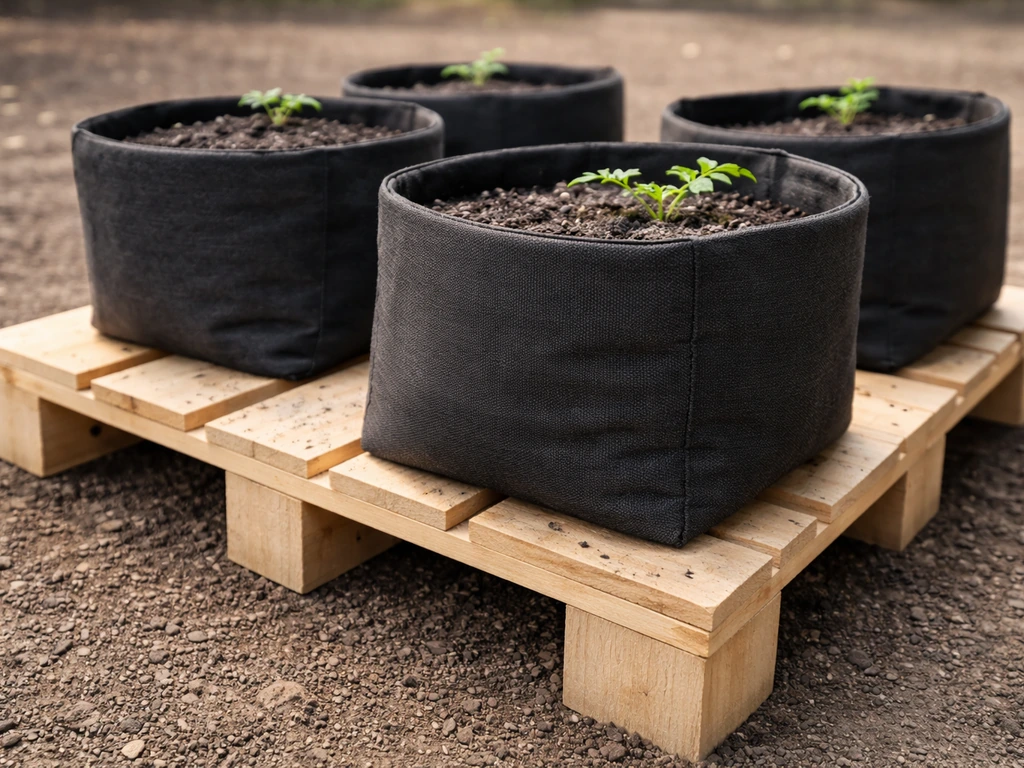
Learn when grow bags must be off the ground, when it’s optional, and how to set them up for drainage and healthy roots.
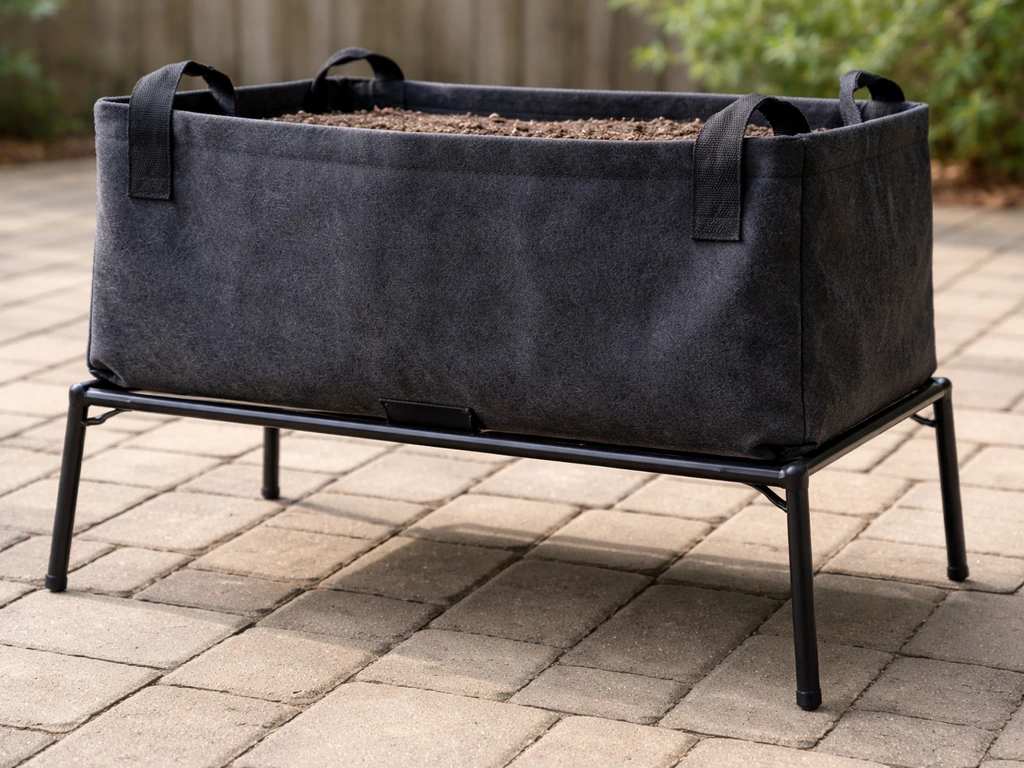
Practical ways to keep grow bags off the ground using stands, blocks, barriers, and drainage bases to prevent rot and pe